
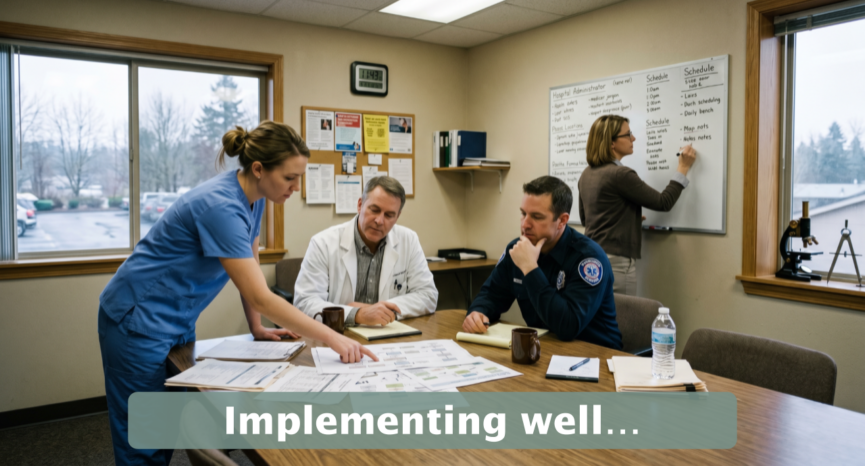
Implementing well…
In a prior article, my colleague Christian Milaster and I made the case that TeleEmergency is one of rural America’s most urgent telehealth priorities — and that the CMS Rural Health Transformation Program presents a great opportunity to fund the closing of that gap for those living and working in rural America. We mapped the three moments where emergency telehealth changes outcomes: at the scene, in the rural ED, and during transport.
But knowing what to deploy is only half the battle.
The harder question — the one that determines whether a program is still running and delivering results three years from now — is how to deploy it.
That is what we’ll cover here.
The Pattern Behind Every Failure
With decades of implementation experience across rural critical access hospitals, FQHCs, community health systems, and statewide programs, our team has developed a repeatable, scalable methodology for successful and sustainable deployment of new services. We apply it in telehealth and digital health rollouts, new service lines, and transformational improvement initiatives.
The failures we see from others are as instructive as the successes — and they share a common pattern: technology was procured before clinical workflows were designed, clinician buy-in was assumed rather than earned, and outcome measurement was treated as an afterthought.
This is the domain of implementation science: the discipline of how evidence-based solutions get adopted, sustained, and scaled in real-world settings. The methodology we use addresses this pattern systematically, moving through seven phases — each one a prerequisite to the next — all grounded in a foundational discipline: define the outcomes first, and let everything else follow from them.
Before a single vendor is evaluated or a single device is purchased, organizations must answer a deceptively simple question: what outcome are we trying to move? Door-to-needle time for stroke. Avoidable transfer rate for cardiac events. Time from onset to specialist consultation for traumatic brain injury. These are the metrics that matter — to patients, to CMS under the RHTP clawback framework, and to hospitals whose operational viability depends on demonstrating value.
Technology is not a strategy. It comes later, but it is not first.
A Seven-Phase Roadmap for Sustainable Rollout
Phase 1: Service Verification
Before committing resources, each TeleEmergency scenario or use case is examined through three lenses.
The strategic case establishes how the proposed service advances the partners’ or the county’s/state’s priorities — not a new agenda, but an acceleration of goals already deemed important. Many telehealth services, in our experience, can credibly move the needle in the right direction on more than 90% of a rural hospital’s strategic objectives.
The financial case projects implementation costs, revenue impact, cost avoidance, and market position with enough specificity to earn leadership approval and show a financially sustainable service.
The clinical case defines how the service improves care — more timely, more effective, safer — and secures clinical sponsorship without which no telehealth program survives its first year.
All three cases are presented to leadership for approval and funding before the project proceeds. This builds genuine commitment — not just awareness.
See: “Verify Before You Start: Can Your New Telehealth Service Deliver?”
Phase 2: Workflow Design and Requirements
The root cause of a failing or underperforming telehealth service is almost never technical. Equipment works. Connectivity is generally sufficient. What breaks down is the human system around it: the unclear protocol for when to initiate a TeleStroke consult, the specialist who was never engaged in workflow design and finds the system intrusive, the ED nurse who does not know how to escalate when the video drops during a critical moment.
Workflow design — developed with clinicians and technicians, not for them — is the implementation work that separates programs that achieve clinical outcomes from programs that merely achieve utilization statistics. This phase also establishes the requirements that drive vendor selection: what the technology must do, in what clinical context, for which users.
Phase 3: Vendor Selection — Hardware, Software, and Services
With specifications in hand, vendor evaluation becomes an exercise in matching requirements to capabilities — not a feature comparison, and certainly not a contest of the most polished sales presentation.
The right platform for a TeleStroke program in a twenty-bed critical access hospital is not the right platform for a regional ED network. Hardware requirements — cart-based versus room-integrated versus mobile — are dictated by the workflows designed in Phase 2, not by vendor demonstrations. Service contracts, including specialist networks, technical support, and training, are evaluated against the support structure the organization will actually have to sustain the program.
Phase 4: Build the Support Structure
Sustainable telehealth programs do not run themselves. Before go-live, the organization must establish multiple layers of support — or it will struggle right out of the gate.
First, a designated program owner with clinical credibility and operational authority. Second, a technical support pathway that does not route rural nurses to a national help desk at 2 a.m. Third, escalation protocols for both clinical and technical failure. And most importantly for long-term sustainability: a performance monitoring framework tied to the outcome metrics defined in Phase 1.
The support structure is not overhead. It is the mechanism through which the program learns, adapts, and improves after deployment.
Phase 5: Develop Training
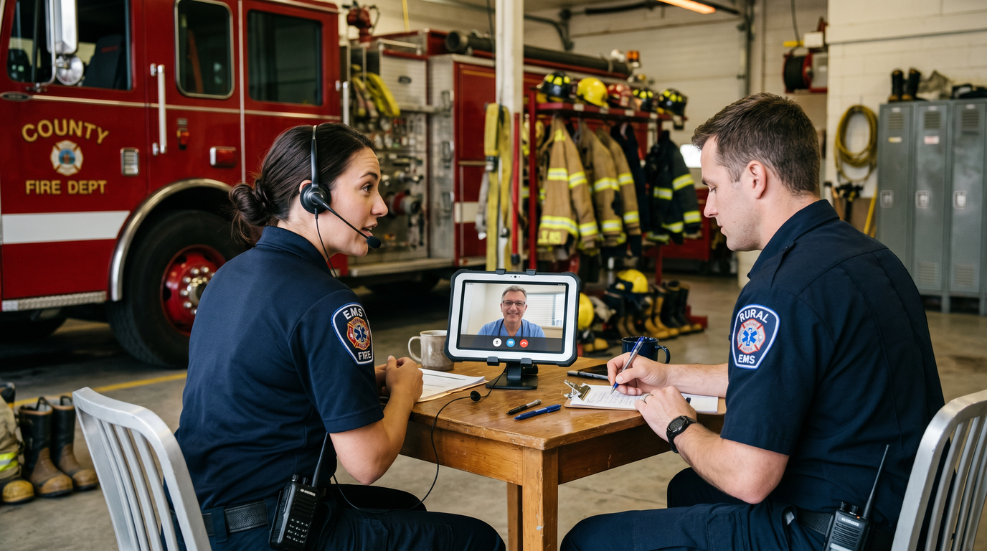
Clinical and technical competence must be built before it is needed in an emergency. Training for TeleEmergency programs is not a one-time orientation — it is a recurring, scenario-based competency program that addresses the full range of users: ED nurses initiating TeleStroke consults, paramedics connecting to remote physicians in the field, transfer coordinators using telehealth to involve specialists in disposition decisions.
Training materials are developed from the workflows designed in Phase 2, tested in Phase 6, and refined continuously for ongoing relevance.
Phase 6: Proof of Concept
Before organization-wide or network-wide deployment, we launch programs in a deliberately constrained environment: a small number of users, a defined set of clinical scenarios, a short but intensive observation period.
The purpose is not to prove that telehealth works — the evidence base for that is decades deep. The purpose is to validate the specific assumptions embedded in this program, at this organization, for these workflows. Do the consultation protocols function as designed? Is the training adequate for the scenarios actually encountered? Can the financial model be confirmed against real utilization data?
The proof-of-concept phase ends not on a calendar date but when the critical assumptions have been validated and the approach has been refined. Sometimes you must move slowly to move fast.
See: “Are you still using Telehealth Pilots?”
Phase 7: Deployment with Performance Management and Continuous Improvement
Full deployment is not a finish line. It is the beginning of the performance management cycle.
Baseline metrics — established before launch — are tracked against targets. Utilization patterns are monitored for gaps that signal workflow or training failures, or early signs of backsliding to old practices. Clinical outcomes are reported to leadership on a cadence that keeps organizational attention on the program.
Under the RHTP framework, these outcomes are not internal management tools only — they are the documentation CMS will require to demonstrate that federal investment produced the rural health transformation it was intended to produce. Programs that were not designed to measure and report outcomes from day one will not survive the accountability cycle of years two and three.
Begin with the End in Mind
The single most important discipline in this entire methodology is also the simplest to state and the hardest to practice: begin with the outcomes you are trying to achieve, and design backwards from there.
CMS is not funding activity or technology purchases under RHTP. It is funding results — reduced time to specialist intervention, fewer avoidable transfers, lower downstream costs from preventable disability and readmission. The baseline must be established before launch. The measurement infrastructure must be built in, not retrofitted.
Sustainability follows the same logic. Financial sustainability means the program cannot depend indefinitely on grant funding — the organizations that benefit most from lower-cost, better-managed emergency care are the ones who should ultimately underwrite it. Human sustainability means a program that quietly reverts to old workflows eighteen months after go-live has not transformed anything. A well-designed performance management system — with clear metrics monitored for early signals of change — is what keeps transformation from becoming a one-time event.
See: “Designing for Telehealth Sustainability: To Launch is Not Enough”
Implementation Science Is Available Now
What has historically been missing in rural emergency telehealth is not the technology, the evidence, or even the clinical will. It has been the disciplined, systematic organizational support — the workflow design, the change management, the rigorous assumption validation, the performance monitoring, and the funding — to deploy these solutions in rural settings and keep them running.
That is precisely what implementation science provides: not inspiration, but method. Not good intentions, but a repeatable process that treats adoption as a design problem — one with known failure modes, proven interventions, and measurable outcomes.
That support is now within reach. RHTP funding provides the financial catalyst. Hands-on technical assistance — from organizations like Ingenium that specialize in exactly this work — provides the implementation backbone.
The question is whether the states, health systems, and organizations responsible for rural emergency care will bring the same rigor to how they deploy these solutions as CMS is bringing to why.
The fastest access to the best care. A generation of rural residents is waiting for this to be consistently true.
My colleague and co-author on this article, Christian Milaster is the founder of Ingenium Digital Health Advisors and has worked in telehealth implementation since 2010, beginning at the Mayo Clinic. Ingenium works with rural healthcare organizations across the country to design, implement, and sustain telehealth programs that deliver measurable outcomes.
Questions for Creating Your Excellence Advantage
✳️ How have you designed in all aspects needed for lasting success?
✳️ Where is the weakest link? How can you shore that up?
✳️ Have you delegated with sufficient clarity about what you mean by “launch”/”implement”? Perhaps your designee would appreciate this information on seven phases for rollout too.
If you’d like to receive these Inspirations in your inbox every other week, you can subscribe to Kathy’s Excellence Advantage Inspirations Newsletter.
Kathy Letendre, President and Founder of Letendre & Associates, advises organizations and leaders to create their excellence advantage.
Contact Kathy by phone or text at 802-779-4315 or via email.