
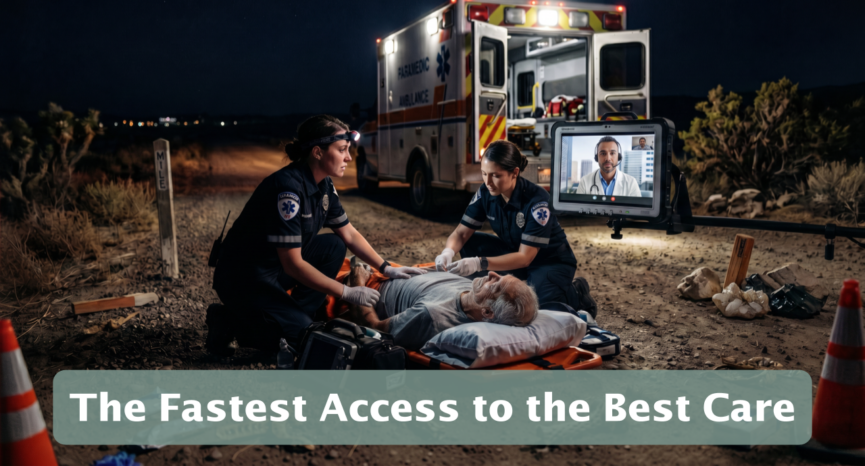
The Fastest Access to the Best Care
Whether you are a resident living in rural America, have a family member who does, or are seeking to understand innovative ways to improve rapid access to emergent, time-sensitive emergency healthcare services across a large geographic area, this piece may offer some ideas worth exploring.
In this whitepaper, my close colleague, Christian Milaster, and I share some ideas that may be happening soon in your neck of the woods.
Co-authored by
Christian Milaster, Ingenium Digital Healthcare Advisors
&
Kathy Letendre, Letendre & Associates // Ingenium Healthcare Advisors
There is a phrase that sums up the entire promise and urgency of emergency telehealth into seven words:
“The fastest access to the best care.”
That is not a cute slogan. It is a clinical imperative — and in rural America today, it is going unmet — at an enormous human and financial cost.
The Problem Is Not Distance. Its Time.
Rural emergency care is not merely a geography problem. It is a time problem. And time, in the conditions that define true emergencies, is measured in irreversible biological events.
Consider stroke. Every minute a large-vessel ischemic stroke goes untreated, a patient loses approximately 1.9 million neurons. The clinical shorthand — “time is brain” — is not hyperbole. It is neuroscience. A patient who receives thrombolytic therapy within 90 minutes of symptom onset has substantially better functional outcomes than one treated at three hours. The difference between those two timelines is frequently the difference between returning to work and entering long-term care — or between survival and death.
The same logic governs severe heart attacks (STEMI), traumatic brain injury, and acute respiratory failure. These are time-sensitive emergencies where the care pathway must compress minutes, not hours.
In rural settings, the pipeline from symptom onset to definitive specialist intervention has historically been broken in multiple places simultaneously:
- EMS response times of 20-45 minutes in frontier counties, versus under 8 minutes in urban settings
- Rural emergency departments staffed by advanced practice providers without on-call specialty backup
- Specialist deserts that are not rhetorical — the last cardiologist on staff at some rural hospitals left 18 years ago and was never replaced
- Transfer times of 90 minutes or more to tertiary centers capable of neurosurgery or cardiac intervention
- No clinical oversight during transport, creating a care vacuum precisely when patients are most unstable
The consequence is not merely suboptimal care. It has measurably worse outcomes: higher mortality, greater permanent disability, longer rehabilitation, and higher downstream costs — borne by patients, families, payers, and communities alike.
And the ambulance driving by the rural hospital, because it is not equipped to help this patient? That lost opportunity to care for the patient further undermines the hospital’s financial sustainability, increasing the risk of closure with even more access to care and jobs lost.
The Human Stakes: What Delayed Care Actually Costs
The financial discussion around rural emergency care often focuses on hospital economics. That is important — and we will address it — but it does not capture the full weight of what is at stake.
A stroke patient who does not receive timely thrombolysis and is left with significant neurological deficits may face:
- Years of occupational, physical, and speech therapy
- Loss of employment and independent living
- Family caregiving burdens that can disrupt entire households economically
- Lifetime skilled nursing or assisted living costs that can exceed $100,000 annually
The total societal cost of stroke in the United States exceeds $50 billion annually. A significant proportion of that burden is attributable to treatment delays — delays that are disproportionately concentrated in rural populations.
Cardiac events carry similar downstream costs. A patient with a severe heart attack who does not receive timely reperfusion — because there is no cardiologist available for consultation, and the rural ED transfers by protocol rather than by informed triage — may suffer preventable damage, leading to heart failure, repeated hospitalizations, and years of expensive chronic disease management.
Mobility lost. Cognitive function lost. Independence lost. Productivity lost. Family stability disrupted. These are the stakes behind every unanswered specialty consultation in a rural emergency department at 2 a.m.
The Hospital Viability Crisis: The System Is Losing Its Capacity to Respond
There is a second, compounding crisis that runs parallel to individual patient outcomes: the rural hospital system itself is failing structurally.
Since 2010, more than 180 rural hospitals in the United States have closed. Hundreds more are classified as vulnerable. The primary drivers are well-documented — thin operating margins, high Medicaid and uninsured populations, workforce shortages, and insufficient patient volume to sustain certain specialty services.
But the mechanism deserves closer attention. Rural hospitals do not simply close because they are unprofitable in the aggregate. They often lose viability incrementally, service line by service line, as specialists depart and are not replaced, and as the hospital’s ability to treat the patients it admits degrades.
When a hospital can no longer manage a stroke patient — because there is no neurologist — it transfers. When it transfers frequently enough, it loses the clinical confidence, the protocols, and eventually the staff to manage complex emergency cases at all. It becomes a stabilization station rather than a treatment center. That is not a sustainable institutional role, and it is not a viable service to the community.
Emergency telehealth directly interrupts this cycle. When a rural ED can access a neurologist within minutes via secure video, it can treat more patients locally, generate more revenue, retain and develop its clinical staff, and sustain the competency that keeps the hospital viable. This is not a secondary benefit. It is central to the business case for telehealth investment under the Rural Health Transformation Program.
The Three Moments Where Emergency Telehealth Changes Outcomes
Effective emergency telehealth is not a single intervention. It maps to three distinct points in the care journey, each with its own clinical logic and its own portfolio of proven solutions.
1. At the Scene: Equipping EMS as the First Clinical Decision Point
When someone collapses from a suspected stroke or sustains a traumatic brain injury in a rural community, the paramedic or EMT on scene is frequently the first — and for a critical window of time, the only — clinician in contact with the patient. The decisions made in those first minutes have outsized consequences.
EMS-based telehealth enables field providers to connect in real time with a remote emergency physician or neurologist, enabling better-informed triage, treatment-in-place when appropriate, and destination decisions that route the patient to the right facility the first time. Combined with remote triage support integrated into dispatch, these models can reduce unnecessary transports, match acuity to resource level, and enable teleneurology assessment — including video-based neurological examination — before the patient reaches a facility.
The Tele Dizzy application developed at Johns Hopkins by Dr. Newman-Toker exemplifies this category. Using oculomotor assessment via video, a neurologist can distinguish central (stroke) from peripheral (benign positional vertigo) causes of acute dizziness with high accuracy — a differentiation that standard field protocols miss roughly 35% of the time, generating unnecessary transfers and missed strokes in equal measure. This model is designed for replication nationally, and its applicability to the rural RHTP context is direct.
2. At the Rural Emergency Department: Bringing Specialty to the Bedside
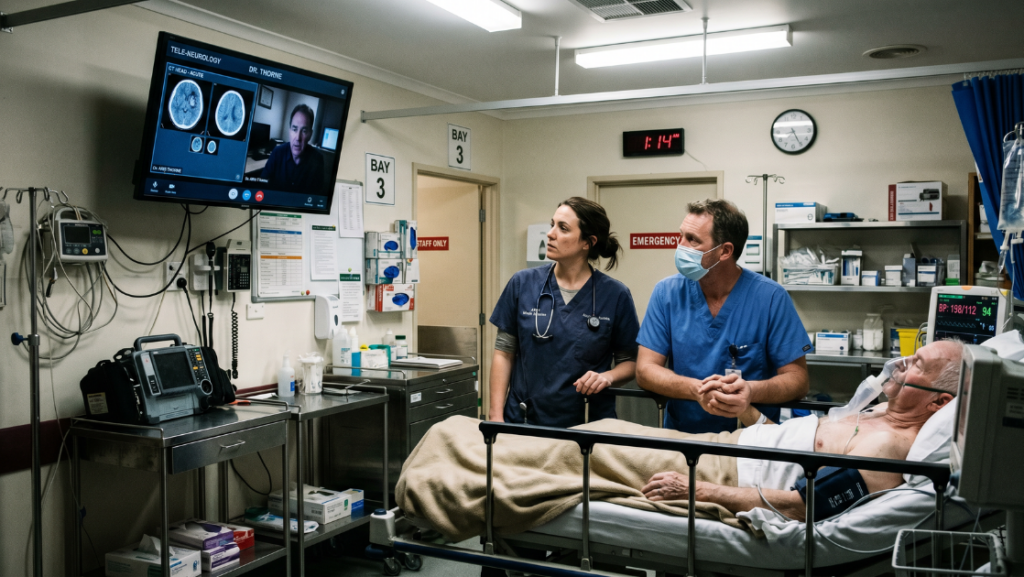
For patients who reach a rural ED, the clinical gap is often not the nurse or the APP on duty — it is the specialist who is not available. TeleStroke, TeleNeurology, TeleCardiology, and emergency TeleBehavioral Health bring those specialists into the room via real-time video, enabling:
- CT interpretation and thrombolysis guidance for stroke patients (proven to reduce door-to-needle times)
- Remote cardiology consultation for heart attack triage, reducing unnecessary air transport
- Psychiatric evaluation for behavioral health crises, reducing the days-long boarding that consumes rural ED capacity and staff bandwidth
- Virtual emergency physician coverage to supplement or replace on-site provider staffing during nights and weekends
TeleED models — in which a remote, board-certified emergency physician provides oversight or primary coverage — have enabled rural critical access hospitals to sustain 24/7 emergency services that would otherwise have required closure or severe reduction in hours.
These are not novel or experimental interventions. TeleStroke programs have been operational since the early 2000s. The evidence base for their impact on door-to-needle times, transfer rates, and patient outcomes is substantial and consistent.
3. In Transport: Closing the Clinical Vacuum Between Facilities
For patients who require transfer — whether by ground or air — the period of transport is among the highest-risk intervals in the emergency care continuum. It is also, historically, among the least supervised.
En-route telemonitoring connects transporting EMS crews with receiving physicians or specialists via 4G/5G or satellite-based connectivity, enabling real-time oversight of patient status, early detection of deterioration, and preparation of the receiving team upon arrival. Transfer center integration with telehealth ensures that specialists are involved in transfer decisions before departure, that necessary diagnostics are complete, and that the receiving ICU or cath lab is ready — rather than encountering a patient whose condition was inadequately characterized during the referring call.
TeleICU consultation at the point of transfer decision can itself prevent unnecessary transfers by enabling intensivist review of the case and recommending local management with virtual backup — keeping patients closer to home when clinically appropriate.
What the Rural Health Transformation Program Makes Possible
The CMS Rural Health Transformation Program represents the most significant federal investment in rural healthcare infrastructure in a generation. With $50 billion committed over five years — explicitly focused on improving access, reducing avoidable costs, and sustaining rural health systems — RHTP creates a funding architecture to close emergency telehealth gaps at scale.
In one state with large swaths of rural and frontier landscape in the West, the Department of Health Emergency Services team has taken on this challenge directly. Using RHTP funds, they are launching a rigorous statewide assessment to map existing capability, identify gaps, and prioritize communities with the greatest need — followed by targeted deployment of financial, technical, and educational resources to develop and sustain emergency telehealth services where they are needed most. It is a model others would do well to follow.
The framing matters. This is not about purchasing technology. It is about building durable clinical capability in rural emergency systems that were structurally incapable of sustaining it independently.
For RHTP, “durable” has a precise meaning — and it operates on two levels.
The first is clinical outcomes. CMS is not just funding activity or purchases. It is funding results: reduced time to specialist intervention, fewer avoidable transfers, lower downstream costs from preventable disability and readmission. Programs that cannot demonstrate movement on those metrics will not survive the accountability cycle that RHTP’s clawback provisions enforce. The baseline must be established before launch. The measurement infrastructure must be built in, not retrofitted.
The second is sustainability — and this is where most programs eventually fail, even ones that launch well. Financial sustainability means that the program cannot depend indefinitely on grant funding to cover services that a payer, health system, or regional network should be underwriting. The organizations that stand to benefit most from lower-cost, better-managed emergency care are the ones that should be paying specialists and EMS for the service: Medicaid, Medicare Advantage plans, regional community health systems avoiding expensive tertiary transfers. — are the ones who should ultimately be footing the bill. RHTP funds are a catalyst, not a permanent subsidy.
Human sustainability is equally critical. A tele-emergency program that works beautifully at go-live but quietly reverts to old workflows within eighteen months has not transformed anything. That retreat is not a technology failure. It is a change management failure — and it is entirely predictable when the organizational culture, clinical habits, and leadership accountability structures were never genuinely realigned. Sustaining new ways of working requires the same disciplined investment as launching them.
We will address exactly how to do that in a future article.
The Opportunity in Front of Us
The convergence of RHTP funding, mature telehealth technology, and a federal commitment to rural health transformation creates a window that has not existed before — and will not remain open indefinitely.
The solutions described here are not hypothetical. TeleStroke programs save function and lives today. EMS-based telehealth is operational in rural counties across the country. TeleICU services are keeping rural hospitals viable. En-route monitoring is technically feasible with existing connectivity infrastructure.
What has historically been missing is not the technology, the evidence, or even the clinical will. It has been the sustained organizational support — the workflow design, the change management, the implementation expertise, and the funding — to deploy these solutions in rural settings and keep them running.
That support is now available. The question is whether the states, health systems, and organizations responsible for rural emergency care will use it with the intentionality and urgency the moment requires.
The fastest access to the best care. Seven words. A generation of rural patients is waiting for them to become true.
Christian Milaster is the founder of Ingenium Digital Health Advisors and has worked in telehealth implementation since 2010, beginning at the Mayo Clinic. Ingenium works with rural healthcare organizations across the country to design, implement, and sustain telehealth programs that deliver measurable clinical outcomes.
Kathy Letendre is a healthcare administrator and rural health consultant with 25 years of experience who has worked with Ingenium for 10 years. Kathy has served rural organizations across the full spectrum of care — from critical access hospitals and FQHCs to community health systems and behavioral health providers; from home health to medical practices.
Questions for Creating Your Excellence Advantage
✳️ How would we all be better off if rapid access to this type of care was not dependent on where you live (urban, suburban, or rural)?
✳️ What is possible when we challenge long-held assumptions?
✳️ How can we continually seek out the best – at the intersection of high quality healthcare and technology-enabled innovation?
The second part of this whitepaper will appear in a future edition.
If you’d like to receive these Inspirations in your inbox every other week, you can subscribe to Kathy’s Excellence Advantage Inspirations Newsletter.
Kathy Letendre, President and Founder of Letendre & Associates, advises organizations and leaders to create their excellence advantage.
Contact Kathy by phone or text at 802-779-4315 or via email.