

You have an ambitious vision. Your board believes in it. Your team is energized by it. But later, when someone asks “How do you know it’s working?,” what’s your honest answer?
If you’re like most visionary leaders, you might point to increased activity, positive feedback, or encouraging anecdotes. But here’s the uncomfortable truth: activity isn’t evidence of impact. Stories aren’t proof of progress.
Ambitious leaders face a unique challenge. The very qualities that often fuel breakthrough thinking—instinct, creativity, tolerance for ambiguity—must be paired with systematic measurement to prove the vision is creating real and lasting change.
Consider this: How many strategic initiatives in your organization have faded not because they were bad ideas, but because you couldn’t demonstrate they were working? How many times have you found yourself defending a promising new program with phrases like “We’re seeing encouraging signs” or “It’s still too early to tell”?
This isn’t a failure of leadership. It’s (simply) a failure of measurement design.
Evidence-Based Leadership
Evidence-based leadership isn’t about abandoning vision for spreadsheets. It’s about ensuring your vision creates measurable results.
Performance measurement expert Stacey Barr defines it simply: evidence-based leaders give their attention to three fundamental differentiators—Direction, Evidence, and Execution. Her book Prove It: How to Create a High Performance Culture and Measurable Success has been a catalyst for my best clients.
Here’s what makes this approach exemplary: instead of measuring activity (How many programs did we launch? How many trainings did we hold?), evidence-based leaders measure results (What outcomes are we achieving? How are lives changing? How are communities better off? ).
Ask yourself: When you review organizational performance, are you primarily looking at what your team did, or what your organization achieved?
Three Areas for Leadership Attention
Direction: Making Strategy Measurable
Many strategic plans read like wish lists. They’re full of noble intentions but lack the specificity needed for good measurement. Evidence-based leaders craft a strategic direction that is results-oriented, understandable, and ruthlessly prioritized.
Here’s a test: Can a front-line employee read your strategic direction and know what success looks like? If not, how can they contribute to achieving it?
Evidence: Moving Beyond Proxy Measures
This is often where many organizations stumble. They measure what’s easy to count (or only what others require of them) rather than what actually matters. Patient satisfaction scores instead of health outcomes. Training hours completed instead of competency gained. Dollars raised instead of people served.
What if instead of asking “What can we measure?” you asked “What evidence would prove our vision is becoming reality?” The shift is subtle but transformative.
Execution: Choosing High-Leverage Improvements
Evidence-based execution isn’t about adding new programs or staffing as the primary solutions. It’s about identifying improvement initiatives that create lasting change with minimal ongoing effort—what Stacey Barr calls “high-leverage” improvements.
Consider this: Instead of hiring more staff to handle increased demand, what processes could you redesign once to permanently increase capacity? Rather than adding quality inspections, what proactive improvements would reduce bottlenecks and ensure greater consistency?

Why This Matters
Evidence-based leadership principles work whether you’re pursuing breakthrough transformation or significant incremental improvements. The approach scales to match your ambitions—from optimizing existing processes to revolutionizing entire programs.
However, ambitious initiatives face unique challenges:
- They often require sustained effort before results become visible
- They challenge existing assumptions about what’s possible
- They require organizational alignment around outcomes that may seem difficult to measure at first
Without clear performance measurement, ambitious initiatives become vulnerable to skepticism, leadership changes, and competing priorities.
A Question That Changes Everything
Here’s the question that separates evidence-based leaders from well-intentioned visionaries: “If our vision is truly transformational, what would be different in the world, and how would we know?”
Not “How would we feel about it?” or “What activities would we be doing?” but “What measurable changes would exist that don’t exist today?”
This question forces clarity about outcomes, not just intentions. It demands specificity about impact, not just effort. And it creates focus on results, not just activity.
Making the Shift
You don’t need to overhaul your entire measurement system overnight. Start with your strategic performance measures!
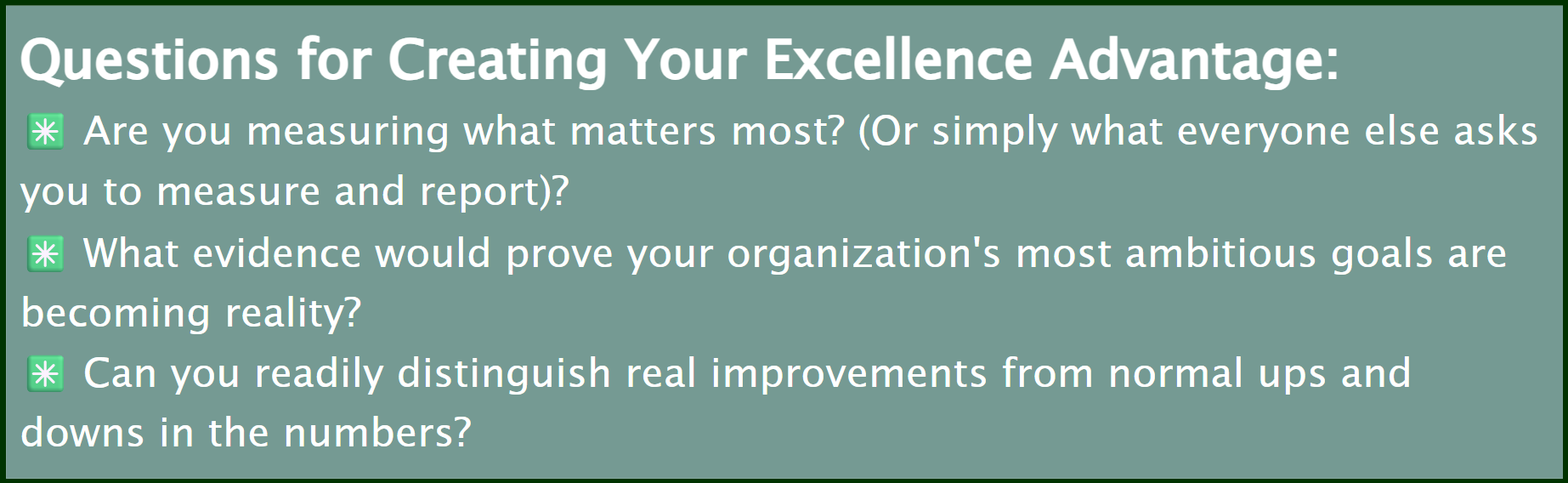
Consider three questions:
- For each of our strategic goals, what specific results would prove we’re succeeding? For example you might move beyond “improve quality” to “reduce readmission rates” or beyond “strengthen communities” to “create access to our services for vulnerable populations.”
- What evidence would convince our biggest skeptic that our strategies are working? This forces you to think like an outside evaluator rather than solely an internal advocate. Seeking tangible evidence that is observable.
- Are signals of change noticeable in the way we graph our strategic measures? What’s the level of performance that would indicate we’re on the right track; and how would we distinguish real progress from normal ups and downs? Breakthrough results often take time, but key performance indicators can provide early evidence of progress, provided you can readily separate meaningful change from (statistical) noise.
The Evidence Advantage
Organizations that master evidence-based leadership gain at least three critical advantages:
They make faster course corrections because they know sooner when something is or isn’t working. They build stronger stakeholder confidence because they can demonstrate impact, not just intent. And they create organizational cultures where everyone understands how their daily work contributes to measurable outcomes.
Most importantly, they transform their ambitious visions from inspiring ideas into measurable realities.
The question isn’t whether your vision is worth pursuing. The question is: How will you know when you’re succeeding?
If you’d like to receive these Inspirations in your inbox every other week, you can subscribe to Kathy’s Excellence Advantage Inspirations Newsletter.
Kathy Letendre, President and Founder of Letendre & Associates, advises organizations and leaders to create their excellence advantage.
Contact Kathy by phone or text at 802-779-4315 or via email.