Growing Leaders… for the Long Game
How High-Performing Organizations Develop Leaders Who Excel — Now and well into the Future
Think about the leaders in your organization — at every level, from supervisors to your senior team. Now ask yourself: Are they well-equipped to lead not just today’s work, but the work your organization needs to accomplish three and five years from now?
In most organizations, the honest answer is: “Some are. Some aren’t. And we haven’t done enough to develop them.”
This is one of the most important investments an executive can make — and one of the most frequently deferred. The urgency of today crowds out the development work that determines tomorrow. But in high-performing organizations, growing leaders is not an afterthought. It employs a deliberate, sustained, and well-designed approach.
What Leaders in High-Performing Organizations Are Expected to Do
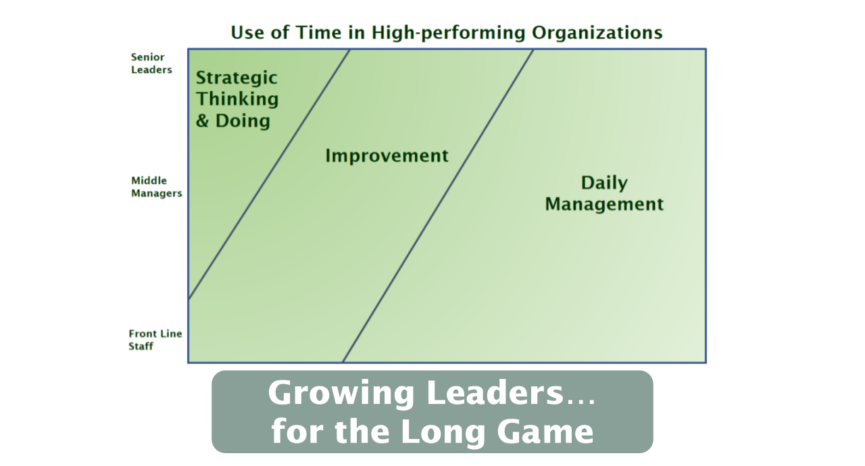
In a previous piece, I described how leaders in high-performing organizations distribute their time across three domains: Strategic Thinking & Doing, Improvement, and Daily Management. Senior leaders devote roughly a third of their time to each. And middle managers, substantial time but in different proportions. The opening image shows this visually. [Note: At the end of this article, you’ll find a link to my prior article on this: the Use of Time in high-performing organizations].
The point to consider is this: not everyone who steps into a leadership role — whether newly promoted or newly hired — arrives with the capabilities to excel across all three domains. And that’s entirely normal. What is not helpful, to them or the organization, is leaving their developmental gaps unaddressed.
High-performing organizations take responsibility for defining the capabilities leaders need to succeed — and then actively developing those capabilities at every level.
A Leadership Effectiveness System: What It Looks Like
Some years ago, I had the privilege of being part of a leadership team in an organization with an extraordinarily ambitious vision — to become an organization of distinction — the best in our industry for our region. We understood that to become an excellent organization, we needed to develop excellent leaders.
So, we did the work. We studied high-performing organizations across the country to understand how the best defined and developed leadership. From this benchmarking, we built what we called the Leadership Effectiveness System — a model I am currently adapting with another organization on a similar journey right now. It has three integrated components.
1. A Leadership Competency Model: Defining the Path Forward
The foundation of the system is a well-defined leadership competency model — one that articulates the specific capabilities leaders need to succeed in the organization, not just today, but in the years ahead.
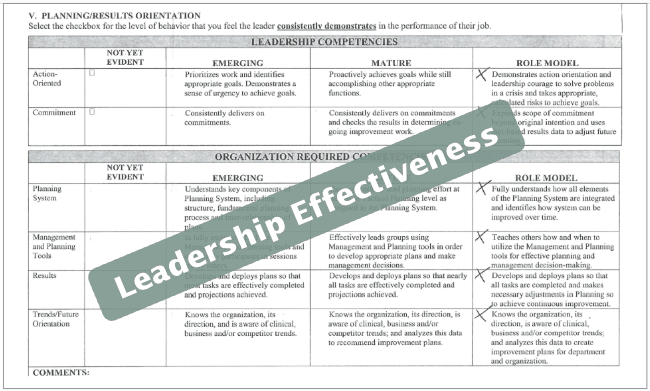
We organize the competencies into meaningful categories and then we did something that proved especially powerful: we defined three levels of mastery for each competency — Emerging, Mature, and Role Model. We describe each level in concrete, behavioral terms, so leaders can see clearly what they are striving for. We do this so that we were not continuously moving the goalpost. It is about painting a picture of the destination: effective & excellent leadership.
Each year, leaders complete a self-assessment using the competency model. Their direct leader gathers 360-degree input — from peers, direct reports, and others with relevant perspective. And then the direct leader completes the assessment as well. What emerges: a rich, multi-perspective view of each leader’s capabilities and opportunities for further development.
Critically important though is that this is not an evaluation exercise. It is a development exercise! The sole purpose of the assessment is to identify the one or two competency areas most worthy of a leader’s focused growth effort in the coming year. Because we take to the time to ensure people understand this distinction, they engage more honestly about areas for growth. The 360 contributors do, too. When development — not judgment — is the spirit of the conversation, people are more forthright about areas for growth and self-improvement. Here is a sample of just one competency area: V. Planning/Results Orientation.
2. Personal Development Plans: Growth That Is Intentional and Individual
The second component of the system is the Personal Development Plan — and I want to be precise about what I mean. This is not a PiP (performance improvement plan for corrective action). This is a growth plan — a forward-looking roadmap for becoming a more capable leader.
Informed by the competency assessment, each leader — in conversation with their boss — selects one or two development priorities for the next year. Then, through a structured conversation and tool, they answer questions that give their development plan real substance:
- What is my vision for improvement in this area?
- What will success look like when I have achieved this?
- How will I be able to lead differently as a result?
- Is this for immediate application in my current role, or to prepare me for greater responsibility ahead?
- How do I learn best?
- How will I know I have been successful?
Leadership development is personal. People learn in different ways. Some grow best through reading and reflection. Others through coaching and mentoring. Still others through hands-on, experiential assignments. Yet others through peer group learning with others in or outside the organization.
A well-designed personal development plan honors this. It meets each leader where they are and leverages how they learn best.
One word of caution that I have observed more than once: leaders sometimes treat their leadership growth area as a private matter. As if it were something to be kept quiet. Here’s the reality — the areas you most need to grow and develop as a leader are not a secret. Your direct reports, your peers, and your colleagues already experience the impact of those gaps every day. As Marshall Goldsmith so aptly puts it, leadership is a contact sport. So I encourage people to bring people in. Let them know what you’re working on it. Ask for their feed-forward. You may be surprised at how genuinely others want to support your growth when they know how you are seeking to improve.
3. Resources and Support: Making Development Actually Happen
A plan without resources is a vision without traction. The third component of the Leadership Effectiveness System is the infrastructure that makes growth possible: carefully curated development resources, individualized and group learning, executive coaching, structured learning paths, benchmarking opportunities, peer cohorts, experiential assignments, special stretch projects, and more.
The best developmental resources I have used with clients go well beyond a list of leadership competencies. They describe what each capability actually looks like in practice — when it’s underdeveloped, when it’s solid, and even when it’s being overused. Resources that provide concrete pathways: for example, how to develop through self-directed learning, through feedback and coaching, through stretch assignments. They give leaders and their managers a shared language and a practical roadmap — not a vague directive to “work on improving your strategic thinking,” but a specific, actionable plan for how to get there based on how others have grown in this similar competency area.
A Critical Insight: Clear Alignment Drives Follow-Through
When I had the opportunity early on to audit and improve the Leadership Effectiveness System across a health system, something became unmistakably clear in examining the results of 60 to 70 leaders each year for three consecutive years:
Leaders who chose development goals that were directly aligned with something they were also responsible for achieving that year in the organization got it done. Their personal development plan was not an add-on — it was woven into their real work. This personal growth was needed to achieve the organizational priority.
Leaders whose development goals were worthy but disconnected from immediate organizational priorities they also had: these were the ones who, when things got hard and time ran out, quietly set their own growth aside. When we are overstretched, most of us prioritize the organization over ourselves. The development goal that feels like an extra is the first thing that slips.
The lesson for leaders who support others’ development: make it real. Connect the growth goal to something that matters now. Development that is embedded in meaningful work is development that actually happens. One cannot be achieved without the other.
Two Leaders. Two Different Paths. One Common Thread.
Let me share the example of two leaders I have had the privilege of working alongside — each a vivid example of what is possible when development is taken seriously.
The first is a CEO who, when I met him, was a director of organizational excellence — a middle manager tapped by the then-CEO to help improve the organization’s performance. This manager recognized quickly that the organization lacked a strategic direction. It had not really thought carefully about what it was trying to achieve.
Over the fourteen years we have worked together since, he grew into becoming the CEO — first as interim, then permanently. And has steadied the organization and righted the ship, within a year of taking the helm.
More importantly, he transformed his organization into an execution engine. They build strategies. They implement them. They get results. Year over year over year. His journey from tactically-focused middle manager to strategically-grounded CEO has been extraordinary to witness and support (as his advisor).
The second leader joined a senior leadership team as a vice president, coming in from a strong clinical operations background in a previous organization. She was deeply knowledgeable, driven, and decisive. But the shift from running clinical operations to leading at a strategic senior level was a major shift at first. Her development path required a different approach to match her style — less direct instruction, more intentional opportunity creation, and gentle role modeling. Through Strategic retreats, senior leadership conversations, and well-designed strategic planning processes, we helped her develop and hone her strategic thinking. Subtly so that she could discover and shine in her own unique style.
Today, she is one of the most strategically-minded leaders I work with! When a director or manager comes to her with an idea, she asks: How does this help us? What are the expected results? How does it connect to our strategic priorities? What will we have to give up? Bring me a plan of how you’d approach this. What other departments will you involve and how?
Her directors and managers still treasure her operational depth. But she leads from a strategic vantage point now. Her strategic thinking and strategic doing is exceptional!
Two people. Two very different starting points. Two very different development paths. But the same commitment: to keep growing, to keep getting better, in service of the people and organizations they lead.
The Gift You Give Your Organization
As Jim Collins reminds us in his work on highly effective leaders, the best among us direct our energy toward building something that will thrive long after we have moved on. {Source: Jim Collins, Good to Great}
Developing your leaders is one of the most enduring gifts you can give your organization. Not just for what the organization needs this year, but for what it will need one, three, and five years from now. For the communities you serve. For the mission you exist to advance.
A few questions worth sitting with…
Questions for Creating Your Excellence Advantage
✳️ Have you defined what leadership effectiveness, even leadership excellence, means in your organization — at every level, from supervisors to senior leaders?
✳️ Do your leaders have a clear picture of the path before them to grow and develop? And what it is expected from them along the way?
✳️ Are development conversations in your organization truly developmental — focused on growth, not just evaluation?
✳️ Are you providing the resources and support leaders need to follow through on their growth plans?
P.S. If you’re interested, here’s that link to my prior piece about the Use of Time in high-performing organizations.
If you’d like to receive these Inspirations in your inbox every other week, you can subscribe to Kathy’s Excellence Advantage Inspirations Newsletter.
Kathy Letendre, President and Founder of Letendre & Associates, advises organizations and leaders to create their excellence advantage.
Contact Kathy by phone or text at 802-779-4315 or via email.