
Excellence Advantage Inspirations: 100th Edition (Part 2 of 2)
From Evidence to Impact: What Happens When Leaders Prove It
This is the second of a two-part series celebrating the 100th edition of Excellence Advantage Inspirations. If you missed Part 1, it explored how Dell Anderson and Renew Behavioral Health began their journey to evidence-based excellence.
Previously, we explored how Dell Anderson and the team transformed a struggling behavioral health department into “Renew”—an organization with an ambitious vision to become a “model of excellence.” We saw how he discovered that despite positive feedback and clean performance audits, he couldn’t actually prove the organization was progressing. And we learned how simply reading Stacey Barr’s book Prove It! led Dell to embrace and implement a Performance Measurement approach known as PuMP, wholeheartedly, with his entire senior leadership team. It has been a pleasure to be their guide along the way and witness their breakthroughs.
Here we highlight the initial results, the cultural transformation, and the practical wisdom gained along the way.
Results That Tell an Unexpected Story
When Renew’s Smart Charts (XmR charts) began revealing trends, the results told a story that surprised even Dell and his team. These strategic insights were a pivotal moment.
Here’s what makes Dell proudest, and it’s probably not what you’d expect. Dell explains their strategic thinking: Our goal is that we have the finance resources available to reach those that need services. Our aim is to expand services to meet that reach and serve more people in need. And if we’re doing that consistently, then our reserves should be driving down, not up, because that will tell us we’re using our financial resources to make services available to those in need.
Read that again. Most organizations celebrate growing net margins. Renew intentionally drove theirs more toward a balanced budget—by investing in programs, services, and supports that enable them to reach more people who need help.
Have you ever thought about financial performance this way? For mission-driven organizations, excess reserves might actually indicate you’re not re-investing enough in your mission.
The data confirmed they were walking their talk: As Dell reflected, we’re seeing this in our key performance indicators. We’ve notably expanded our reach in our county. This is where the Smart Chart revealed something even Dell hadn’t fully appreciated. The numbers showed growth from serving 1,200 unique individuals in 2018 to approximately 4,600 individuals annually in the recent year—a 283% increase.
But as I (Kathy) observed when we looked at the Smart chart together, “They’ve really had at least three stair steps up. Dell and his team knew they were growing, but I think until seeing that XmR chart in that way, they had not realized how many stair steps of growth they had truly made and that they were at a completely different level of performance.”
This is the power of visualizing data over time. Dell knew they’d grown. But seeing the three distinct performance shifts on the chart made the magnitude of their achievement visible in a way numbers in a table alone never could.
As I noted, “We often measure services in terms of encounters and visits, but really Renew’s purpose is to provide the appropriate number of visits, but to reach more people.” The XmR chart showed they were succeeding at what mattered most—not just providing more services, but reaching significantly more individuals in need.
Growth through strategic expansion. To achieve this reach, Renew had opened new sites and added virtual visit services through their “Connected Care” program, ensuring individuals across the entire county could readily access services—whether in-person at one of their seven locations or virtually.
Dell is clear about where they are in the journey: “We’ve also recognized there are impacts that need further improvement. Those are ones we’re focusing on to see what difference we can make as we create projects to drive improvement in those areas.”
Does this sound familiar? Real excellence isn’t about perfection. It’s about knowing where you’re succeeding, where you need to improve, and having the evidence to guide your next steps.
Staff Involvement That Changed Everything
One of the most powerful aspects of Renew’s journey has been staff engagement—and what it revealed about organizational culture.
After designing their initial strategic-level measures, the leadership team organized what they ultimately called a “Feedback Luau.” This is Step 4 in PuMP where we seek broader input and feedback. At Renew, we had ~80% of staff come out. Dayana Ruiz, manager of performance excellence, and the senior leadership team took this out as a rotating “measures gallery” to three different locations so staff could participate where most convenient to them.
But here’s what makes this remarkable: After gathering the input, we worked through every single line of feedback, taking every sentence through a decision process about what to do with it.
How many organizations collect feedback and let it sit in a file somewhere?
Then came an unexpected discovery. One of the things that became evident was that the organization really didn’t have a good mechanism by which staff could give ongoing feedback. We received volumes of feedback because we had created a safe space for people to share pent up ideas.
Think about your organization. Do you have real mechanisms for staff feedback? Or do ideas and concerns just fester with no approach for soliciting them and acting on them?
The team didn’t just collect feedback—they acted on it. “We took all that feedback, improved the Results Map, improved the performance results themselves, and initiated actions.” So that going forward staff would be able to see their input shaping the strategy and measures.
The Data Walk That Highlighted Impact
More recently, Renew held a “Data Walk” as part of an all-staff meeting. Dell describes the setup: “We created posters for each strategic initiative in our strategic direction. On those posters was the goal, the initiative, and the measures. We had 10 posters stationed around the room…and at each one, we had a senior leadership member responsible for that focus group who could answer any questions.”
Staff walked through at their leisure, saw the charts visually displayed, asked questions, and provided feedback, live or anonymously if they chose.
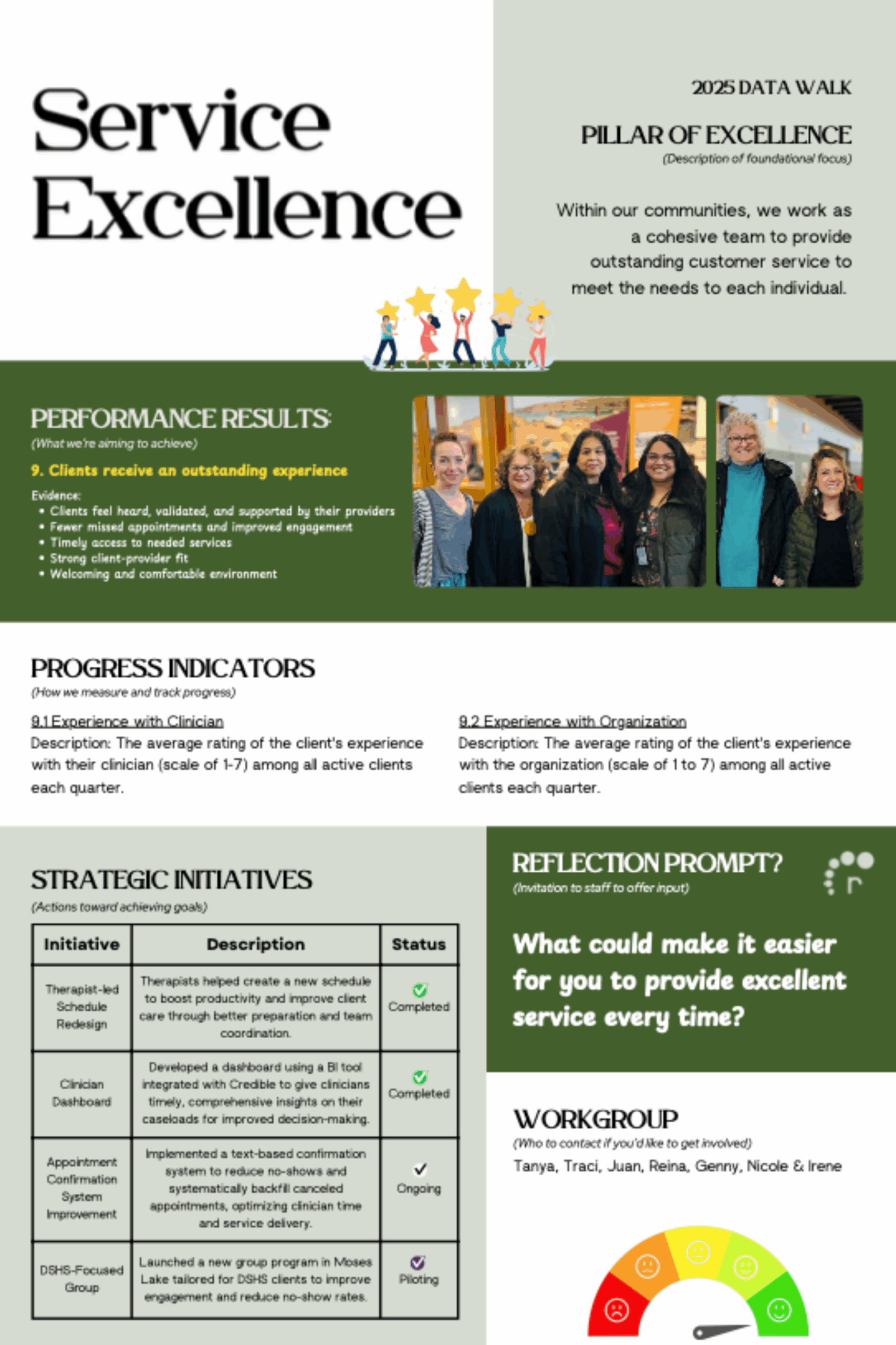
Dell shares what stands out most: “One of the most valuable pieces of feedback was a staff member who said, ‘they’re actually listening to us. I can see what we asked for in the measure.’ That was exciting for me because that’s been the whole purpose—for staff to see what value their individual experiences as an employee have on the overall goal of the organization.”
Do your staff have that clarity and see how their contribution matters?
The impact extended far beyond feedback mechanisms. Dell reflects on the cultural shift: “It helps staff build trust in the management team. They can share their opinions without any retaliation or retribution. They’ve been able to trust that part of the process. One thing I’ve learned through the PuMP process is that at least they’re sharing, even if it’s negative. They’re feeling open to sharing their feedback and what opportunities they see that we can improve upon.”
As I observe this transformation across Renew: “I really believe it’s changing the culture. It’s truly having that level of impact. When staff can see that an initiative they were part of links back into a result…people want to be a part of this.”
Stacey Barr, creator of PuMP, captured the broader significance: “This isn’t just about evidence-based decision-making and measuring stuff. This is having a ripple effect much bigger than that.”
As I see it from my performance excellence perspective, “Measurement is the fuel. It’s the fuel that powers the organization. It’s about measurement that’s aligned to where we’re going. Measurement that launches needed improvement efforts, leading to results.”
More Leadership Lessons Learned
Beyond the insights shared in Part 1 of this article, Renew’s journey offers additional wisdom:
What commitment looks like in practice. As I describe our approach at Renew: What we committed to is that we bring each meaningful measure to life as it’s ready. We’re not waiting for all the strategic measures to be ready. But as each one is ready, we gather the historical data, and graph it on the XmR chart to understand performance levels. From that understanding we begin to do the target setting and then causal analysis. We set improvement priorities and monitor impact.
This is progress over perfection in action. You don’t need to have everything figured out before you start. You need to start and improve as you go.
The ultimate goal: everyone sees their impact. Dell articulates why this drives everything: “The ultimate goal is that every individual employee will see their impact as an individual in the organization. They’ll be able to see that in the plan and as part of the process. They’ll know they’re valued in the organization and how they make an impact. I truly believe it doesn’t matter what your position is—your work is important. But you need to be able to see that impact, so that story can be told.”
Stacey Barr responded to this with admiration: “That’s awesome. That’s almost a 180-degree flip from where a lot of organizations would be trying to position measurement with their people. It would be more about measurement to keep people performing well…And you’ve just described a 180-degree flip where this is used to help them understand and appreciate the value they contribute. I love that.”
How does your organization position measurement? As a tool for control or a tool for clarity about contribution?
What Makes This Journey Unique
Today, Renew Behavioral Health serves Grant County across seven locations plus virtual services. They provide a wide array of services, including outpatient mental health case management, mental health therapy, medication management, substance use treatment, 24-hour crisis response, foundational community support (housing and employment services), and wraparound intensive programs for children and youth.
But what makes Renew unique isn’t the scope of services—it’s how they’ve integrated evidence-based leadership into their organizational DNA. So that their services are continually improved and making a difference.
Dell recently presented their strategic direction and progress to the Board of Commissioners. Going back in time, Dell explains what they asked when he got trained in PuMP’s Evidence-Based Leadership and the Baldrige Fellowship Program: How are we going to see this utilized throughout the program? If we’re going to invest into leadership development and strategic performance measurement processes, we need to see it’s being utilized.”
Dell delivered. They have embedded the principles of organizational excellence throughout their strategic direction, and further have shown how Prove It! and the PuMP process has yielded more meaningful measures for each strategic element, allowing them to monitor progress and demonstrate impact over time.
For me, watching Dell’s leadership has been inspiring: Dell is very humble. To see what they’ve accomplished in just five years under his leadership—it’s remarkable. They’ve really reestablished their presence in the community and the internal culture is truly changing. They have a strategic direction. An approach to improvement. Mechanisms for staff to provide feedback and participate in improvement efforts. Plus they have metrics that can tell their story of impact, to accompany the changes they’re experiencing.
During a recent recorded interview with Dell, Stacey Barr observed something equally important about Dell’s approach: “What I’m hearing in how you’re sharing this, Dell, is it’s coming from you and your language and your perspective, not indoctrinated PuMP language. It’s coming through how it’s shifted and changed how you’re thinking and how you’re working with your team and discovering things about Renew through measurement.”
This ownership—this internalization of evidence-based thinking—is what distinguishes Renew’s journey from organizations that merely adopt tools without embedding them to transform their culture.
The Journey Continues
Renew’s next steps are as intentional as their vision. Dell explains: “We’re going to start cascading these processes into each of the different programs. The programs can then develop their own goals and their own measures to drive the program direction,” aligned with the goals and values of the organization.
Stacey Barr recognized the foundation they’ve built for this next phase: “I’m super impressed with how much of a strong strategic foundation you and your team have built. That makes the next natural thing—cascading into teams—more likely to flow. It’s not going to be easy as this is hard work, but it’s going to have more of a flow to it.”
She continues: For staff to know that their feedback is valued and trusted and acted on, for them to see the transparency and the work you’ve put into making a strategy that speaks their language and that they can connect with…that next phase I imagine is going to flow really well.
Dell agrees, acknowledging both the challenge and the progress: “It’s not perfect yet. This is continuous improvement and it’s something we’re working on. But it has given staff the ability to provide their feedback, which they didn’t have before. There wasn’t a systematic way for them to do that.”
His final assessment: “I believe PuMP is worth it. I believe this is a worthwhile add-on to fact-based leadership. I think it takes fact-based leadership to another level. It’s a way you can really communicate across your system how well you’re doing as an organization, what processes most need to be improved, to continue on this journey of excellence.”
What drew me to work with Renew in this way and why their story matters: “To aspire to excellence, one has to be able to measure and improve! It’s about continuous improvement. I’m so grateful to have had the opportunity to utilize PuMP’s evidence-based leadership approach with Renew. They’ve been an amazing partner because they believe so much that their clients and their communities deserve nothing but excellence.”
It’s been a joy to work with them and continue to work alongside them to truly integrate this into the way they lead. It’s not something else; it is their leadership system. It’s changing the conversations, changing what they focus their energy on, and it’s truly changed the conversations the senior leaders are having with each other and with teams.
Stacey Barr’s closing reflection captures the broader significance: “To know that Renew can now have an even bigger impact more quickly and easily than before is just a massive reward…seeing something I created so very long ago [PuMP] reaching halfway across the world and helping people that need help to have a better life really, really touches me.”
Your next actions
As you consider your own organization’s journey of improvement and excellence, Dell’s example invites some specific actions:
- Ask the hard questions. Gather your leadership team and ask: “What evidence do we have that we’re accomplishing our vision?” Not compliance evidence—but evidence that you’re fulfilling your mission and achieving the results that matter most, including, to those you serve. What answers emerge?
- Create clarity with plain language. Take your vision, mission, and goals. Can you explain each phrase so clearly that a 10-year-old would understand? If not, start there. Clarity precedes measurement. (This is what is accomplished early on in the PuMP process).
- Look for trends, not points. In your next data review meeting, resist reacting to individual peaks and valleys. Instead, ask: “What’s the pattern over time? Is performance stable, improving, or declining? Are we moving toward our desired level of performance?” This one shift – not reacting to individual data points – can transform your meetings, but more importantly free up immense time that can be devoted to improvement work.
- Create feedback mechanisms. Do your staff have safe, systematic ways to provide input? If not, this might be the most important starting point. You can’t build a true culture of excellence without staff voice.
- Learn alongside your team. Whatever journey you begin, model collaborative learning. Your team will trust the process more and own the results more deeply.
- Be patient but committed. As Dell learned, this takes time—especially if you need to build data collection systems from scratch. But as he emphasizes, “the end result is tangible. You’re able to tell the story of where you are as an organization and how you are progressing.”
Through this process, Dell learned that excellence is “this ability and flexibility to continuously improve your processes and really begin that journey of performance improvement.”As my favorite quote says: Excellence isn’t an accident. It requires high intention, sincere effort, intelligent direction, and skillful execution.
It also requires evidence to guide the journey—and the humility to let that evidence change your mind and your actions!
That’s what separates organizations that hope they’re making a difference from those that know they are—and can prove it.
To learn more about Renew’s experience, including visuals depicting their evidence-based leadership approach, visit the full case study interview with Dell at PuMP.academy
If you’d like to receive these Inspirations in your inbox every other week, you can subscribe to Kathy’s Excellence Advantage Inspirations Newsletter.
Kathy Letendre, President and Founder of Letendre & Associates, advises organizations and leaders to create their excellence advantage.
Contact Kathy by phone or text at 802-779-4315 or via email.