

The 5 Leader-Ships of Innovation Adoption
“The Future is already here; it is just not evenly distributed.” — William Gibson
Today’s Healthcare Leaders have a full plate of important and urgent priorities and many if not all of them require some form of organizational transformation: compelling the organization to do things differently, often radically so, than before.
At its core, leadership boils down to three key responsibilities: (1) setting a vision, (2) enrolling a team to commit to achieving the vision, and (3) holding the team accountable to their commitment.
In order to lead transformation in the age of innovation, we postulate that every leader must master these five Leader-Ships of Transformation:
- Innovation Leadership
- Change Leadership
- Project Leadership
- Process Leadership
- Improvement Leadership
In the following five sections, we will lay out the mindset and leadership traits that leaders must exhibit to succeed in each area.
Innovation Leader-Ship
Leading innovation is mostly concerned with the use of limited resources to adopt, adapt, or create innovative solutions. This can be new innovative technologies (such as Telehealth, Digital Health, or any form of AI), innovative clinical care solutions, or innovative and proven management methods (such as agile, 4DX, or management by fact).
Given the avalanche of innovation (which AI will only accelerate), to lead innovation well, leaders must guide their team to
- Create an Innovation Evaluation and Prioritization System to assess solutions that solve the organization’s high-priority problems.
- Create a rapid Innovation Validation System that quickly determines the quality and fit of the solution.
- Create a systematic, scalable Innovation Implementation System that can effectively deploy proven innovation across the organization.
With these three elements in place, the organization can now quickly assess the viability and feasibility of a new digital health solution in days, validate it in weeks, and deploy it system-wide in months.
With many non-traditional competitors steeped in rapid innovation adoption (e.g., Amazon, Walmart, Best Buy), healthcare organizations must learn to improve their speed (and accuracy), if they want to stay in business.
Change Leader-Ship
Whether it is the switch to a new telehealth platform, the rollout of RPM for chronic care management, or the implementation of new software that uses AI — the successful adoption hinges on the organization’s ability (i.e., the people’s willingness) to accept the change.
As an executive leader, some of the aspects of managing change fall on you and your senior leadership team. Other aspects, however, should be owned by and executed by your teams.
One very useful change management model is the Prosci Institute’s ADKAR® model. When all of its five elements (Awareness, Desire, Knowledge, Ability, and Reinforcement) are in place, change will happen fast and the change will last.
It is leadership’s responsibility to raise Awareness (“here’s what this change is about”), create Desire (“here’s why this change is important to us”), and provide Reinforcement (“are you still doing what you’re supposed to be doing now?”).
It is also leadership’s responsibility to delegate to and hold to account others who will provide the Knowledge and the Ability (skills) to adopt and implement the change. This includes for example the review of process designs, training materials, and effectiveness evaluations.
Project Leader-Ship
The art and science of Project Management have been around for many decades, initially perfected in the construction industry and civil engineering.
In healthcare, for the most part, project management (if it is even used) still seems to be limited to large-scale IT rollouts and even then, many projects still fall short of their goals and leadership’s expectations.
A project, by definition, is a temporary endeavor undertaken to achieve a specific outcome. This definition fits a vast number of initiatives that leadership teams want to get done, but proven project management principles that have been used for at least two decades in other industries are rarely applied.
Over the years, facilitated by the US-based Project Management Institute, a standardized approach to project management emerged that distinguishes the five project phases of initiating, planning, executing, monitoring & control, and closing.
Within each phase, proven principles such as project charters, project management plans, work breakdown structures, stakeholder management, risk management, etc. have been defined and refined over the years and are documented in the periodically updated Project Management Body of Knowledge.
Those certifiably proficient in the theory of project management and its application in the real world (as demonstrated by the completion of a number of projects) can earn industry-recognized certifications such as the CAPM® (Certified Associate in Project Management) or the PMP® (Project Management Professional). After leading exam study groups for 3 years, I held the PMP certification from 2007 through 2015.
While it is certainly not the leadership’s role to manage projects, I’m sharing this information so that leaders can set a standard for how projects should be managed. Worldwide, there are over 370,000 PMP certification holders in the US, demonstrating clearly that other industries have embraced the need for qualified individuals to manage projects.
Project Leadership means that leaders expect that their projects are led by individuals who are well versed in the profession of project management – whether with or without a certification.
Process Leader-Ship
In essence, all of healthcare operations are a process: a series of actions taken in order to achieve a particular goal, create a certain result that satisfies the goal.
Whether it’s the scheduling of an appointment, the rooming of a patient, the ordering of an X-ray or the referral to a specialist. The delivery of care from diagnosis to treatment is a series of interdependent and interconnected processes. E.g., here is a description of the seven telehealth workflows that need to be defined in order to create a great experience for clinicians and patients alike.
Similar to project management, the design of highly effective, scalable, and sustainable processes is a science and an art. While there is no unified “body of knowledge” or certification to obtain, those proficient in the design of processes have learned their craft through repeated learning.
For example, here are some of my core process design principles:
- be clear about the process’s goal
- study the current process first
- involve all key stakeholders
- keep the process simple
- document every process
- focus on the “happy day scenario” first – what should happen 80% of the time
- systematically develop “alternate scenarios” for what should happen when things don’t go as planned
- implement process performance measures
- apply insights to improve the process
- etc.
What I have found over the years is that especially the lack of documented “alternate scenarios” can wreak havoc on a process, leading to the Pareto principle where 20% of the scenarios are costing 80% of the effort.
From a leadership perspective, it’s imperative that leaders insist that their project teams identify, document, and train on all processes (that also helps with the “Knowledge” and “Ability” part of change management).
Improvement Leader-Ship
Last but not least is the Leadership of Improvement. Most people are content with maintaining the status quo (“don’t rock the boat”) but we know from nature that standing still begets atrophy — the slow deterioration of value, quality, performance, etc.
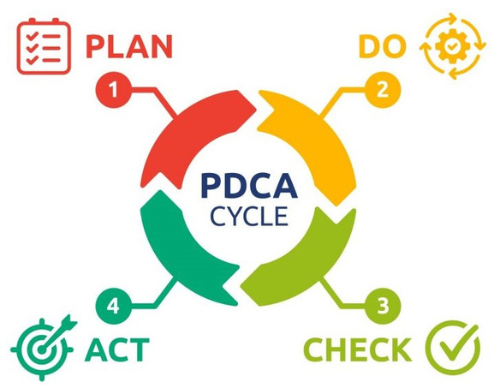
In an ever-changing environment, all aspects of systems, solutions, or processes need to be continually improved and it’s the leaders’ role to provide that accountability.
Decades back the quality movement brought us the now widely used tool of “Plan-Do-Check-Act”. The notion of KPIs, Key Performance Indicators, aids leaders in assessing the performance and initiating an intervention if performance is not in line with their goals or expectations.
Improvement rarely happens on their own, especially since people working within the processes are used to the current performance and rarely notice a deterioration in quality in performance. Given leadership’s role of “Reinforcement” as postulated by the ADKAR model, it is the responsibility of leadership to ensure that all deployed innovation is constantly improved on, when the current performance does not match what is needed.
Leading Organizational Transformation
Leading organizational transformation through the continuous adoption of innovation is key to today’s organizations’ survival. Continuous improvement alone does not cut it anymore, but rather new services need to be launched, new technologies need to be integrated, new staffing and work models must be applied, and innovative solutions must be evaluated and adopted on an ongoing basis.
When leaders truly lead innovation adoption (1) with a change management (2) mindset, when they insist that industry-proven principles of project management (3), process design (4), and continuous improvement (5) are being used by their staff, then the success of the organization is all but guaranteed.
If you’d like to receive these Inspirations in your inbox every other week, you can subscribe to Kathy’s Excellence Advantage Inspirations Newsletter.
Kathy Letendre, President and Founder of Letendre & Associates, advises organizations and leaders to create their excellence advantage.
Contact Kathy by phone or text at 802-779-4315 or via email.