

From Burnout to Breakthrough: Improving Capacity and Satisfaction Without Adding Staff
How one organization stopped blaming the people and started fixing the system — and what your organization might learn from their journey.
Here is a question worth sitting with:
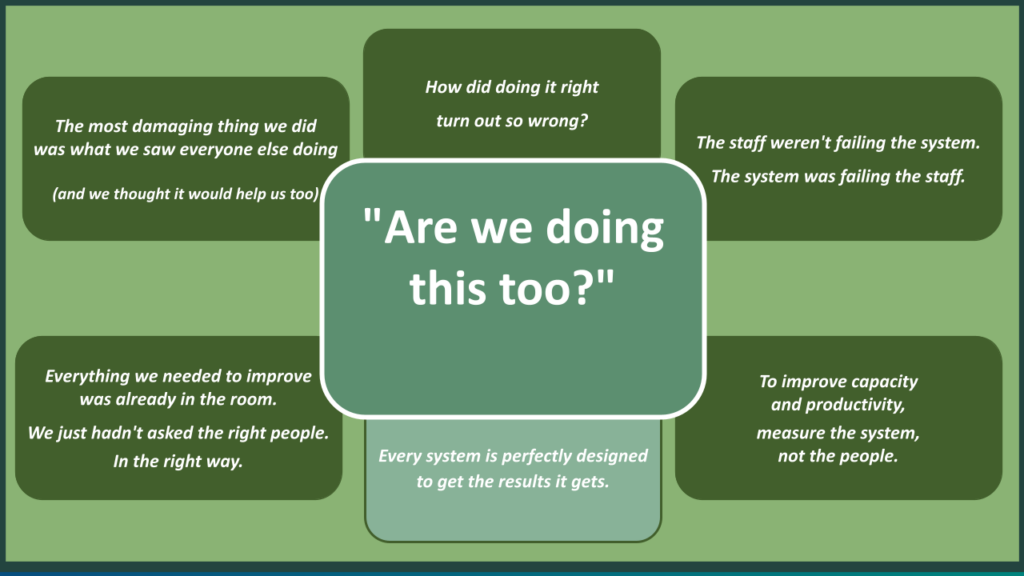
How did doing it right turn out so wrong?
That is the question that Dell Anderson, Executive Director of Renew, found himself asking not long ago. And it is a question I suspect more than a few of you — leading organizations in healthcare and human services right now — have quietly asked yourselves too.
Renew is a mission-driven, designated behavioral health organization serving individuals and families across Grant County, Washington struggling with substance use and serious mental health challenges. For years, Dell and his team were doing what nearly every leader in the sector does when client demand rises: They opened more appointment slots. They pushed harder. They tracked individual productivity numbers of clinicians. They focused on individual productivity in the way they saw everyone else doing — and believed it would help.
It didn’t.
The Most Damaging Thing We Did Was What We Saw Everyone Else Doing
The pressure to meet individual productivity targets was quietly taking a toll. Burnout among clinicians crept upward. No-show rates among clients remained stubbornly high. Scheduling was a daily struggle. Handoffs between clinicians and support staff lacked clarity. Caseloads felt unmanageable. Staff were doing their individual best — and still falling short of what the productivity goals demanded.
When Renew’s leadership looked honestly at what was happening, something important became clear. This was not a failure of effort. The clinical and support team was working hard. It was, in fact, a failure of system design.
The scheduling approach didn’t meet the increasingly complex needs of their clients. Documentation was time-consuming and disruptive at times to clinical flow. Processes that should have been seamless — appointment confirmations, caseload management, coordination between team members — were ad hoc, reactive, and exhausting.
As Paul Batalden’s oft-cited observation reminds us: every system is perfectly designed to get the results it gets. Renew’s system was perfectly designed, if you will, to produce exactly the burnout, the no-shows, the productivity levels, and the capacity ceilings they were experiencing. Not because anyone intended it that way, but because the system had never been deliberately examined — and redesigned.
What seemed like a people problem was actually a system problem. And that realization changed everything.
The Staff Weren’t Failing the System. The System Was Failing the Staff.
When I partnered with Dell and his team on this, we began to dig deeper. Seeking to uncover the root causes and potential solutions through the eyes of staff. Asking the people closest to the work with a genuine, facilitative curiosity and an eagerness to bridge insights from one focus group into the next. What emerged was transformative.
More than 30 employees engaged in interviews and focus groups. Staff completed an improvement survey at a 90% response rate — a remarkable signal of trust and engagement. Clinicians, case managers, and support staff were invited into structured conversations to surface what was actually getting in the way: the real bottlenecks, the daily frustrations, the workarounds people had built just to survive the day.
What emerged was illuminating. The barriers weren’t mysterious, although they were entrenched. Solutions were hiding in plain sight — in the scheduling system, in documentation workflows, in the gap between how the workday was designed and how clients actually showed up and needed to be served.
As Renew’s Clinical Director, Juan Padilla, reflected: “So many valuable changes came out of this work — things we never would’ve identified on our own. What seemed minor at first turned out to have a major impact on morale, staff support, and the overall health of the organization.”
This is a truth I have seen again and again in high-performing organizations: everything you need to improve is already in the room. You just have to ask the right people, in the right way. Often with a skillful and “neutral” guide to draw out and find synergy from across the multitudes of insights shared by staff.
It was a true partnership. Dell set the tone for staff to share openly and honestly. I created the environment where this could occur through several different listening mechanisms. I synthesized massive amounts of information (both numerical and narrative data) to distill key insights for action. And Dell and his team were receptive to hear and act.
What Changed — and What It Produced
Armed with direct insight from clinicians and support staff, we designed a set of practical, systems-based changes. Not sweeping mandates handed down from above, but carefully considered improvements shaped by the staff who would live with them every day.
Staff willingly volunteered to test them out and collect and share data during the experimentation phase.
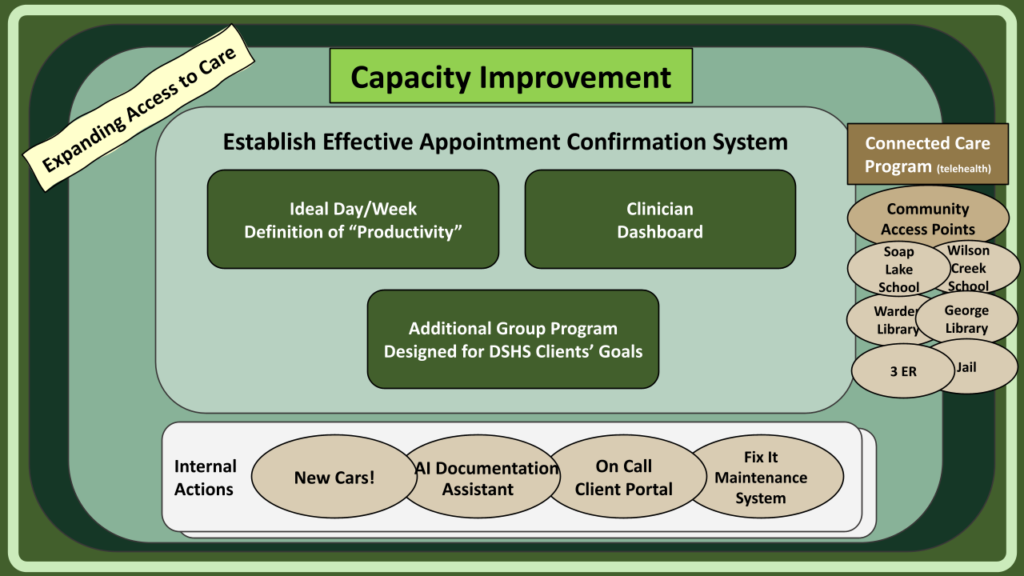
There were several improvements made as illustrated above. I highlight here just a few:
Ideal Day and Ideal Week scheduling. Clinicians worked with me to define what an optimally structured workday actually looked like — building in appropriate rhythms for direct client service, documentation, care coordination with other members of the team, time to ensure future appointment slots are all full, follow-ups with clients who missed an appointment, and breathing room to decompress between trauma-related appointments. The result was a less reactive, more predictable workday. Clinicians reported feeling far more in control of their time, less burned out, and more productive each day.
A proactive appointment confirmation system. Rather than relying on labor-intensive, ad hoc phone calls, clients now receive a number of systematic reminders before each appointment. This greater advance notice and clarity of roles among staff have turned cancellations into filled slots from the waitlist — improving both client access, clinician-staff teamwork, and schedule efficiency simultaneously.
A new group program designed around shared client needs. By creating a group program format for clients with a very common and specific treatment goal, who have also historically had a very high no show rate, has freed up 15 to 30 hours per month for case managers — time redirected to serving individuals with more complex, individualized needs. More clients served now. No additional staff. Better utilization of clinical time.
Real-time clinician dashboards. Tools were created that give clinicians genuine visibility into their own schedules and caseloads — not productivity reports that ranked them against their peers, but practical instruments that help them manage their own work more effectively.
Clearer handoffs and role clarity across teams. The behind-the-scenes coordination that had been generating frustration was restructured so that clinical and support staff shared a common understanding of who does what, when, and how.
The results of these and the full suite of improvements made speak for themselves. Staff retention — which stood at 74.5% in 2021 — climbed to 93.4% by 2025. Overall staff satisfaction rose meaningfully year over year (2024 to 2025). Unique clients served grew from about 2,200 in 2018 to more than 5,000 by 2025. Treatment completion rates trended upward. And…as Dell reflected: “In my five years here, this is the first time we’ve seen every clinician on the therapy team consistently meet the service delivery expectations. That kind of alignment and follow-through is a major shift for us.”
A therapist on his team put it simply: “I feel far more satisfied at the end of each day — not overwhelmed or burned out.”
The Insight That Changes the Conversation
Here is a core discovery from Renew’s journey — one that I believe holds important lessons for every organization striving for continuous improvement and even excellence:
If you want to improve capacity and productivity, measure the system — not the people.
This is a significant shift in perspective for many organizations in the healthcare and human services sectors. It requires a willingness to look honestly at how work is actually organized and accomplished — not how we wish it were, and not simply how it looks on an org chart, in a workflow, or in a policy manual.
Individual productivity reports that rank clinicians against numerical targets may feel like accountability. In practice, they often do something far more damaging: they create pressure without creating insight. They identify that performance is below expectation, but tell us almost nothing about why — and nothing at all about what to actually fix.
Measuring the system is different. It means examining patterns and groups who work within a system. It allows us to spot bottlenecks and experiment with improvements such as scheduling logic, workflow design, communication processes, documentation burden, role clarity, and the dozens of small structural choices that either support people in doing their best work — or quietly undercut them, day after day.
This is not about lowering the bar. It is about building an organization where doing excellent work is genuinely possible.
A Question for Your Organization
You don’t have to be a behavioral health organization to recognize yourself in Renew’s story. The dynamics that Dell and his team confronted — rising demand for services, constrained staffing and resources, pressure placed on individuals rather than systems, staff who are genuinely committed but increasingly depleted — are playing out across healthcare and human services organizations of every shape and size right now.
And the path forward is the same: stop assuming it is a people problem. Start asking whether your system is designed to set your people up to succeed.
Dell shared something that stayed with me: “This process hasn’t just transformed the organization — it’s transformed me. It’s completely changed how I approach supporting staff and engaging our leadership team.”
That is what genuine systems thinking does. It doesn’t just solve the operational problem in front of you. It changes how you lead.
Questions for Creating Your Excellence Advantage
✳️ Where are you measuring your people when you should be studying your system? What would you discover if you examined your workflows, scheduling, and processes through that lens?
✳️ When did you last ask your staff — in a structured, genuinely curious way — what is getting in the way of their best work? And what did you do with what they told you?
✳️ Where in your organization might burnout be signaling a system design problem rather than a performance problem?
If you’d like to receive these Inspirations in your inbox every other week, you can subscribe to Kathy’s Excellence Advantage Inspirations Newsletter.
Kathy Letendre, President and Founder of Letendre & Associates, advises organizations and leaders to create their excellence advantage.
Contact Kathy by phone or text at 802-779-4315 or via email.