
Are You Delivering What Matters Most?
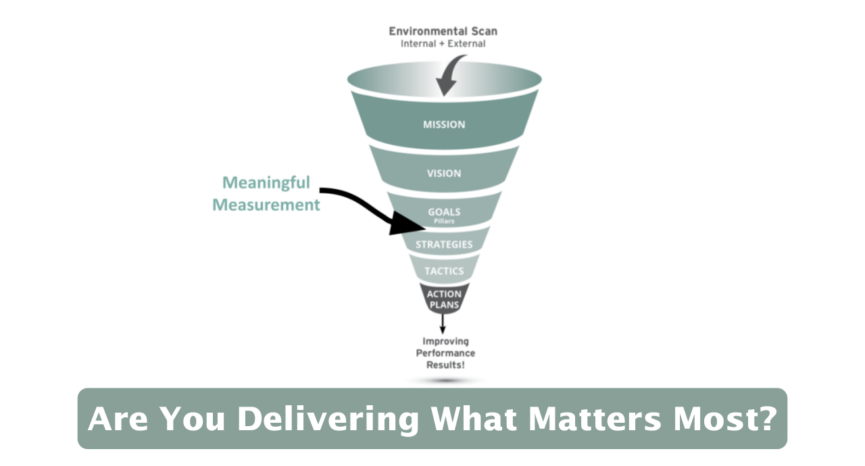
I often invite leaders to think about strategic planning as a funnel, not a fire hose.
It is about making intentional choices—throughout the planning process. Choices about how we will spend our precious time, energy, money, and resources on what matters most.
In the top half of the funnel, we set our strategic direction. In the second half of the funnel, we develop our plans (the strategies, tactics, and actions) to bring that direction to life.
And all of this…done well…has one ultimate purpose:
Planning is not for planning’s sake. Planning is for improving performance results. Which results? The results that matter most to the organization.”
In this article, I’ll share why so many organizations end up with meaningless measures, and how a simple shift—slipping in meaningful measurement at the right point in the planning process—can transform your ability to execute strategy and achieve the impact you intend.
The Strategic Planning Funnel: Top and Bottom
Think of the funnel in two main parts.
1. The Top: Setting the Strategic Direction – the What and the Why
This is where we articulate:
- Our Mission (or Purpose) – Why we exist
- Our Vision – What future we are trying to create
- Our Goals (or pillars) – The major outcomes or shifts we seek
Done well, our strategic direction answers two critical questions:
- What are we trying to achieve? and
- Why does this matter? (In other words: What is the impact or results we seek?)
Too often, organizations do a reasonable job with the what but are vague about the why. Others intermingle what, why and how in their strategic statements and then wonder why staff don’t understand what we are working toward and therefore how they contribute.
High-performing organizations are explicit about the what and the why, by defining their goals with the results/ impact/outcomes they are trying to create.
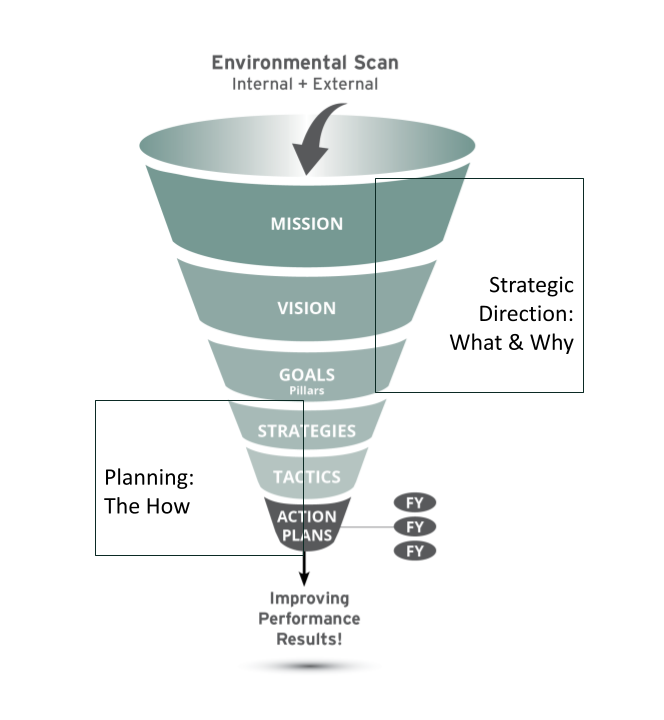
2. The Bottom: Planning – the How
In the planning phase, here we move into what many typically think of as strategic planning. Determining the:
- Strategies
- Tactics
- Action plans
These are simply different levels of specificity about how we will fulfill our mission, advance our vision, and achieve our strategic goals. Many organizations work in cycles at the action planning level—setting actions for 90-day, twice a year, or annual (fiscal year FY) cycles. We must continue to thoughtfully prioritize (think funnel) as we choose and then implement our change initiatives (action plans).
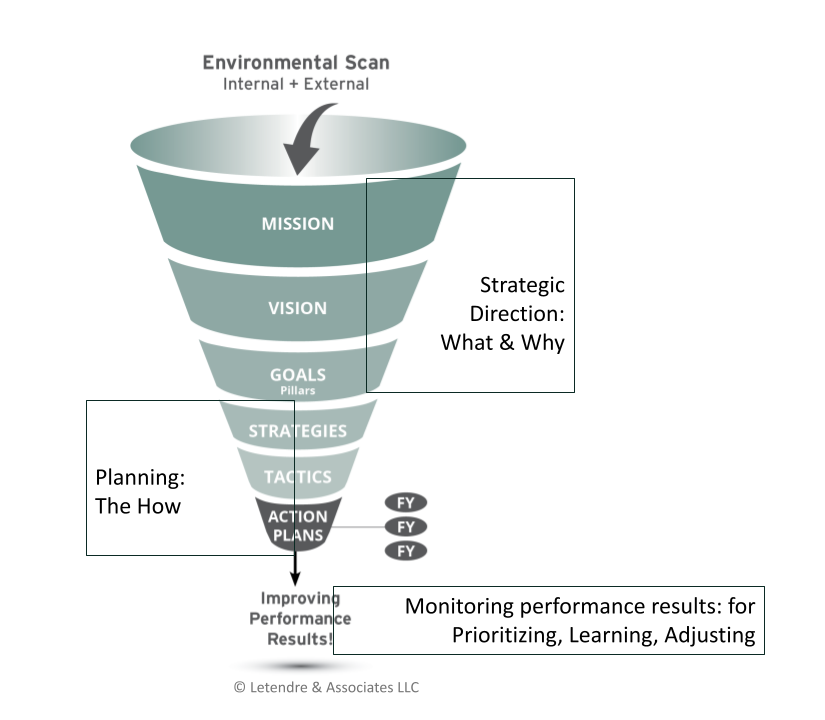
What emerges from planning done well: improving. performance. results.
Our performance results—and a disciplined way of using those results—helps leaders and teams to:
- Prioritize what matters most (for the next period of time).
- Learn (not judge) what is working and not working.
- Adjust strategies and actions accordingly.
Two Common (and Costly) Measurement Mistakes
Even organizations with well-crafted strategic plans often struggle to execute consistently and effectively. Two very common habits get in the way:
#1: Defining results and measures after action planning
#2: Jumping to a “dashboard” too soon, often with existing measures
Mistake #1: Defining Results and Measures After Action Planning
In many organizations, the sequence looks like this:
- Conduct strategic planning
- Decide on action plans
- Then, knowing they should “measure”, ask, “what should be our measures”
- Attach measures to the actions they’ve chosen.
Unfortunately, measuring at the action plan stage leads to activity-based measures or project management-type measures that are often trivial, and not strategically meaningful. They end up with measures that sound like:
- Number of training sessions delivered
- Number of hours of staff training
- Number of outreach events held
- Completion of energy efficiency upgrades by June 2027
These may be useful to a specific department (for example, the education team), but they are not strategically meaningful at the organizational-level. These measures don’t tell us whether we are achieving the results that matter most.
This happens because the measurement conversation occurs too late, at the level of action, rather than right after the setting of strategic direction and results.
Mistake #2: Jumping to a Dashboard too soon, often with Existing Measures
The second common pattern I see all too often:
“Get me a dashboard.”
Leaders ask for a dashboard, and teams respond by pulling together the measures they already collect—often because they’re easy to access, not because they are most meaningful to the articulated strategic direction.
The problem? When you set a new strategic direction—a refreshed mission, vision, and set of goals—the measures you’ve always used may not:
- Reflect your (new) priorities
- Capture the desired impact you seek to achieve
- Provide direct evidence if you’re achieving your mission, vision, or goals.
You end up with a dashboard of convenient measures, not evidence of strategic progress being realized.
A Better Way: Slip in Meaningful Measurement
High-performing organizations do something different:
They define meaningful measures much earlier in the process—between setting strategic direction (mission, vision, goals) and finalizing strategies, tactics and action plans.
Visually, if you imagine the funnel, they insert meaningful measurement: Right between the “goals” layer and the “strategies” layer.
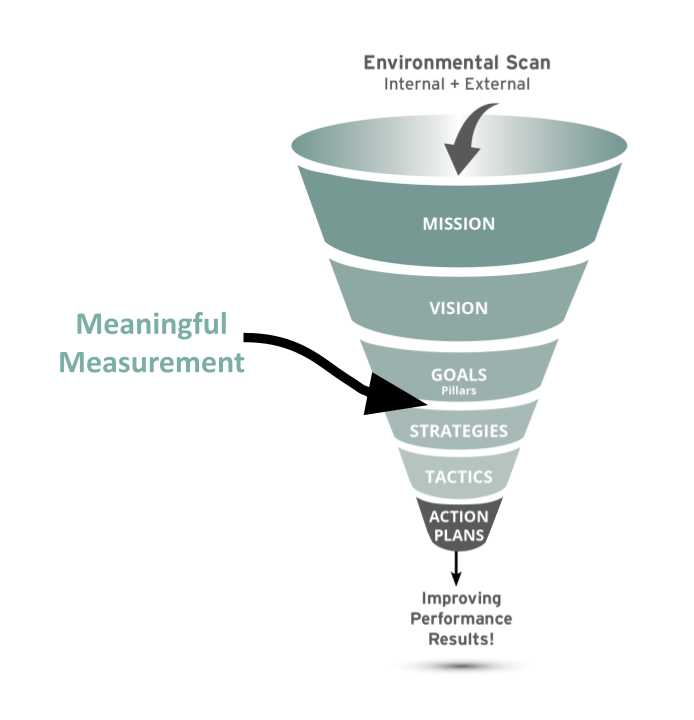
This is where we intentionally bridge:
- From what we want to achieve and why,
- To how we will enact change—guided by evidence, not intuition.
What Is “Meaningful Measurement”?
Meaningful measurement is not about volumes of data or scores of KPIs. Rather, it comes through clarity of intention, disciplined thinking, and a few specific techniques. It is about deciding on strategic metrics that are most meaningful, not trivial.
Defining meaningful strategic performance measures (KPIs) has several key elements, and ideally occurs in this sequence:
1. Start with Results: Our Core Intent
We begin with clear answers to:
- What are we truly trying to achieve?
- What impact or outcome or results are we seeking that matters most here?
This is not a list of activities. It is a statement of change. For our patients, customers, community, staff, or system.
My best clients do this in setting their strategic direction (what and why).
2. Identify the Evidence of That Result occurring
Before we talk about (or jump to) measures or metrics, we ask:
- What would we see, detect, or observe if this result were occurring?
- What would be different than today?
This moves us from vague ideas about good metrics to concrete and direct evidence of the result occurring. We stay at the level of evidence (for the next step too), still not yet going to numbers.
3. Quantify the Evidence
Only then do we ask:
- What are the different ways we might quantify this direct evidence?
We explore several possible ways to quantify the best evidence that would convince us that we are achieving (or progressing toward) the desired result.
And then we select the one (or possibly two) best ways to express that evidence in quantitative terms for each key result.
At this point, we arrive at our Strategic Key Performance Indicators (KPIs):
Result → (Best) Evidence → (Best) Quantification → (Meaningful) KPIs
For many organizations, even just doing these three steps well is a significant leap forward from their typical approach.
How High-Performing Organizations Go Further
Once high-performing organizations have identified their strategic KPIs, they take an additional critical step or two:
4. Bring the KPIs to Life with Historical Data
They collect and review historical data on these chosen key performance indicators (KPIs):
- How have we performed over the last several quarters? What about the last few years?
- Are there signals of change in our performance over time—improvement, decline, or stability?
This longer, historical view gives context for the KPI, allowing us to:
- See whether any improvement has already been occurring, and if so, how much
- Determine whether the system delivering the result is stable or changing
- See what is predicted into the future if no new strategies are enacted
- Avoid overreacting to normal variation and therefore being able to more clearly spot real shifts over time.
With this insight about performance, they can then:
5. Set Priorities and Aims for Improvement
Armed with a clearer understanding of performance, they ask:
- What level of improvement (or change) are we seeking?
- What is our aim for this KPI, and over what period of time?
- Are we seeking a breakthrough level of change, or will incremental improvement get us to where we need to be?
Some call these targets; I also think of them as aims. The crucial point is that the aims are grounded in direct evidence of where we’ve been and where we are, not wishful thinking.
When meaningful measurement is “slipped in” at this point in the planning process described above, before selecting final strategies and actions, organizations end up with:
- More focused and targeted strategies, tactics, and action plans – often addressing root causes not symptoms
- Actions that are guided by evidence of current reality and desired level change
- A clearer understanding of the size of the gap between where they are and where they intend (or need) to be.
This is no longer theoretical. It’s data-informed strategy. And equally important, results-driven strategy execution.
Why This Approach Is Not Yet Common
If this approach is so powerful, why don’t more organizations use it? I offer a couple of ideas.
Habit and Tradition
Many organizations cling to the way they’ve “always done things,” including in strategic planning:
- Write the plan
- Attach measures (or repurpose existing metrics we have at hand),
- Create a dashboard.
This idea of instead inserting a disciplined, evidence-focused measurement approach as you are defining strategies is new for many leaders and Boards.
The Illusion of Ease
The other reason, it feels easier—initially—to:
- Use measures that are already at hand
- Rely on data that is already being collected, sometimes for entirely different purposes (like what you have to report to your regulators)
- Accept “close enough” measures because the work of defining meaningful ones requires more thought.
But what seems easier in the short run often undermines strategy execution in the long run.
The Power of Meaningful Measurement
Organizations that adopt a more structured and practical approach experience profound shifts:
- They end up with measures that directly evidence their mission, vision, and big goals, instead of superficial activity counts or project management trackers.
- They learn to interpret their KPIs, not just report them—able to distinguish between noise and real change in performance.
- They use measures to generate insight, not judge people.
In my view, this is one of the most important reasons we measure:
We measure to create insight—and that insight informs our improvement priorities…our strategies, tactics, and actions.
When we monitor over time using those same meaningful KPIs, we genuinely know if we are achieving the results we set out to achieve.
With clarity and insight, we can:
- Prioritize the areas where we most need strategies and actions
- Learn what is working and what is not
- Adjust our plans rather than hold tight to strategies that aren’t delivering results.
This is how we move from planning on paper to delivering the results that matter most.
Trigger Phrases to Watch For
There are certain phrases I hear that signal an organization may be using less than effective approaches to measurement:
- “Get me a dashboard.
→ Often means: “Use whatever data we already have,” rather than, “Let’s define the best evidence of our results.”
- “This measure is close enough,” or “We already measure something like that.”
→ Often means: “I don’t fully understand the purpose of strategic measurement.” or “I don’t see the value in redefining our measures at this point.”
Meaningful measurement requires a more rigorous, intentional, and disciplined thought process. The good news: it does not need to be time-consuming. It does, however, require us to be purposeful.
Anchoring Measurement to What Matters Most
At the end of the day, meaningful measurement is about anchoring our metrics (KPIs) to provide evidence that we are achieving what we set out to do:
- Fulfill our mission
- Reach for our vision
- Advance our big strategic goals
These are things that matter… as we usually articulate them with great care. Our performance results—and therefore our measures—should be direct evidence of progress toward those ambitions.
To recap, high performing organizations:
1. Set strategic direction by clearly articulating both the what and the why—the results and impact you seek.
2. Slip in meaningful measurement before finalizing strategies and action plans:
- Start with results (our core intent)
- Identify direct evidence of those results
- Determine the best way to quantify that evidence, selecting one or two of the most meaningful KPIs for each key result
- Collect historical performance (where feasible) for these KPIs and set our aims for level of improvement
3. Then finalize the design and execute strategies, tactics, and actions that are explicitly designed to close the gap between current performance and your desired results.
As some of you know, structured approaches such as PuMP offer a step-by-step way to do this well. It’s not the only method, of course, but it is the most powerful way I have experienced. A methodical approach can change the conversation to find more meaningful measurement—and thereby change the course of and outcomes from your strategic implementation efforts.
When we slip in meaningful measurement at the right point in our planning process, we:
- Execute strategy with greater confidence and competence
- Keep the focus on the results that matter most
- Make better decisions, faster, and informed by evidence
- And ultimately, achieve our mission, vision and goals more reliably.
Questions for Creating Your Excellence Advantage
✳️ Do you recognize your organization in the all too common approaches—setting measures after action planning, asking for a dashboard and getting whatever is easily available, or settling for “close enough” metrics?
✳️ How might your planning conversations change if you identified results and their evidence earlier in the process?
✳️ Do you currently know whether your strategies, tactics, and actions are working as intended?
If you’d like to receive these Inspirations in your inbox every other week, you can subscribe to Kathy’s Excellence Advantage Inspirations Newsletter.
Kathy Letendre, President and Founder of Letendre & Associates, advises organizations and leaders to create their excellence advantage.
Contact Kathy by phone or text at 802-779-4315 or via email.