The Question Many Leaders Avoid (But Shouldn’t)
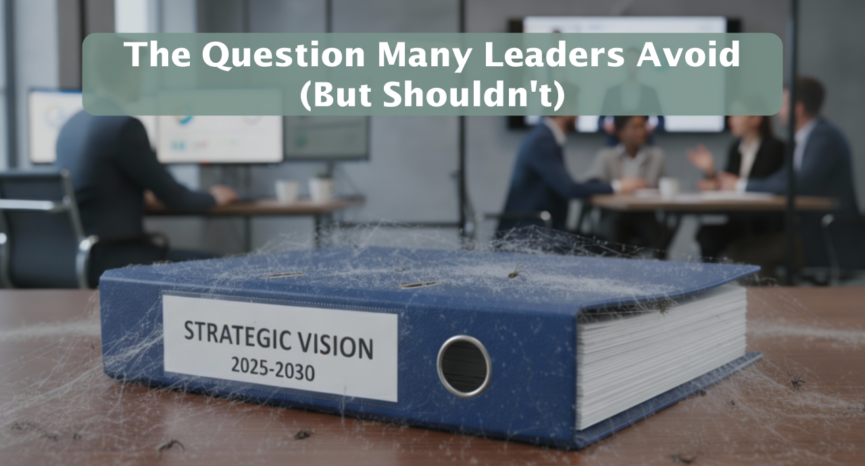
Your strategic direction sits in a binder. Or maybe it’s a beautifully designed slide deck. Perhaps it’s even framed on the wall. But when was the last time someone on your team used it to make a decision in their work?
Here’s a harder question: If your board asked you right now to prove your strategy is working, what would you say?
If you’re like many leaders, you’d point to completed initiatives, share positive feedback received, or describe increased activity levels. You might say “It’s still early, but we’re making progress.”
But here’s what you’re really saying: “I’m not fully sure, but I hope so.“
Strategic execution shouldn’t require hope. It requires evidence, and learning from the evidence. It starts with two deceptively simple but foundational questions that my colleague Brook Rolter uses as a core framework:
- Are we achieving what we want to achieve?
- How do we know?
Many leadership teams struggle to answer either question with confidence. Not because they lack competence or commitment, but because they’ve never framed their strategic work in this way.
Today, let’s tackle the first question. In a future article, we’ll explore the second—and why answering both can transform how organizations operate.
The Clarity Problem
Consider what happens in organizations that can’t answer “Are we achieving what we want to achieve?”:
- Strategic priorities shift with each new crisis or opportunity.
- Improvement initiatives launch based on intuition rather than evidence.
- Teams work hard on projects that may or may not move the organization closer to its goals.
- Years pass, and no one can definitively say whether the strategy succeeded or failed—so the cycle repeats.
The challenge many organizations face is that their strategic direction isn’t results-oriented or understandable to everyone. Rather it is action-oriented, voluminous, and uses language that is vague.
Your strategic plan might list five priorities. Or seven. Or twelve. But for each one, can folks in your organization explain why it matters? Can they describe what will be different or better when that goal succeeds? Not in vague aspirational terms or jargon, but in plain language that anyone can understand and act on?
Without this clarity, trying to answer “are we achieving what we want to achieve?” becomes nearly impossible. Every problem seems equally urgent. Every stakeholder’s need appears equally valid. You can’t distinguish between the results that matter most and everything else competing for attention.
What Will Be Different?
Here are critical questions that bring clarity: When we achieve this strategic goal in the coming years, what will be different? What will be better? What is the outcome we are seeking?
This is where many strategic plans fall short. They describe areas of focus or list initiatives, but fail to articulate in plain language what result the organization is seeking to achieve and why it matters.
For example, if your strategic goal is “improve client health outcomes,” what result are you seeking? What will be better? Perhaps “patients will have the confidence to manage their chronic health conditions” or “clients will avoid unnecessary emergency room visits.” If your goal is “strengthen community connections,” what will be different? Maybe “isolated individuals will have supportive relationships” or “more community members will be engaged in local programs.”
Notice the difference. These aren’t technical objectives or activity lists. They’re clear statements about what will change—expressed in language everyone can understand.
Here’s how one leader described what had been missing: It’s very important to us to provide strong evidence as to the range of services and the outcomes, value and impact delivered by our organization. And that was missing.
Her team articulated their goals in results-oriented language, making it clear to everyone—from front-line staff to board members—what results they were seeking to achieve and why those results mattered. Then they captured this clarity visually in what is called a Results Map. The real power came from the shared understanding of what would be different when they succeeded. And the Map helped them to see the cause-and-effect relationships between these results.

Starting With Clarity
You don’t need to overhaul everything overnight. Start with your most important strategic goal(s).
Ask: What result are we seeking to achieve? When we accomplish this goal in the coming years, what will be different? What will be better? Can I explain this in plain language that anyone—staff, board members, community partners—would understand? The mindset I often use is: how could I explain this to my niece in 5th grade.
This clarity brings life to your strategy. They are not words on a page, but rather results we are collectively working toward. Across the organization, we share a common understanding of why this goal matters and what will be better when we achieve it.
This clarity is essential. Because once you can clearly articulate what result you’re seeking to achieve, you create momentum. Teams can identify how they can contribute. You can assess where you are starting from. You can prioritize strategies and actions that will have the greatest impact.
And you can also move to answer the second critical question: How do we know?
That’s where we’ll turn in a future article.
So, can you clearly articulate what will be different when your organization achieves each strategic goal? If you can’t answer that question in plain language, neither can anyone else on your team. Or they answer it in a way far different than you intended!!
Strategy should guide decisions and actions. Clearly articulated strategy guides the entire organization toward the results that matter most, that everyone understands and can pursue together.
Questions for Creating Your Excellence Advantage
✳️ Are you achieving what you want to achieve?
✳️ Do your strategic goals articulate the results you are seeking to achieve?
✳️ Does your team have a common understanding of the difference you are seeking to make as an organization?
If you’d like to receive these Inspirations in your inbox every other week, you can subscribe to Kathy’s Excellence Advantage Inspirations Newsletter.
Kathy Letendre, President and Founder of Letendre & Associates, advises organizations and leaders to create their excellence advantage.
Contact Kathy by phone or text at 802-779-4315 or via email.