
5 Qualities of Excellent Organizational KPIs
Today’s article is co-authored with Stacey Barr, creator of Pump’s Evidence-Based Leadership Approach.
For many organizations, key performance indicators (KPIs) or measures or metrics are an essential and integrated part of their strategic management. For others, KPIs are not (yet) used strategically to the organization’s advantage.
Many organizations have weak organizational KPIs. They don’t align to strategy, give evidence of impact, or offer actionable feedback. If they can’t do these things, they can’t really be called organizational KPIs.
Organizational, or strategic, KPIs are the performance measures that the senior leadership team uses to steer the organization into the future, to successfully execute the strategy. They should describe and measure what matters most!
But excellent organizational KPIs can be hard to find without a systematic approach. Sure, many organizations find the financial goals and accompanying financial KPIs easy enough. But for non-financial goals, the KPIs are too often trivial – simply measures of activity, measures of what everyone else measures, or measures of milestone achievement.
We find it’s because they lack certain qualities that excellent organizational KPIs need:
Quality #1 – Excellent organizational KPIs are attached to a strategic goal.
When a KPI or measure is attached to an organizational goal, we call that ‘KPI alignment‘. It means that there isn’t just a list of corporate KPIs – there is a clear relationship between each KPI and each strategic goal.
For example, an energy and water authority has four specific goals, two of which are:
- “Provide leadership for the energy and water supply sectors”
- “Improve outcomes for stakeholders and customers”
They also have a list of four KPIs, but they don’t visually or logically align to their goals. One KPI is “Stakeholder regulatory compliance”, which might align to one of the above goals. But it would be poor direct evidence of either. And none of the KPIs align at all with the other two goals they have.
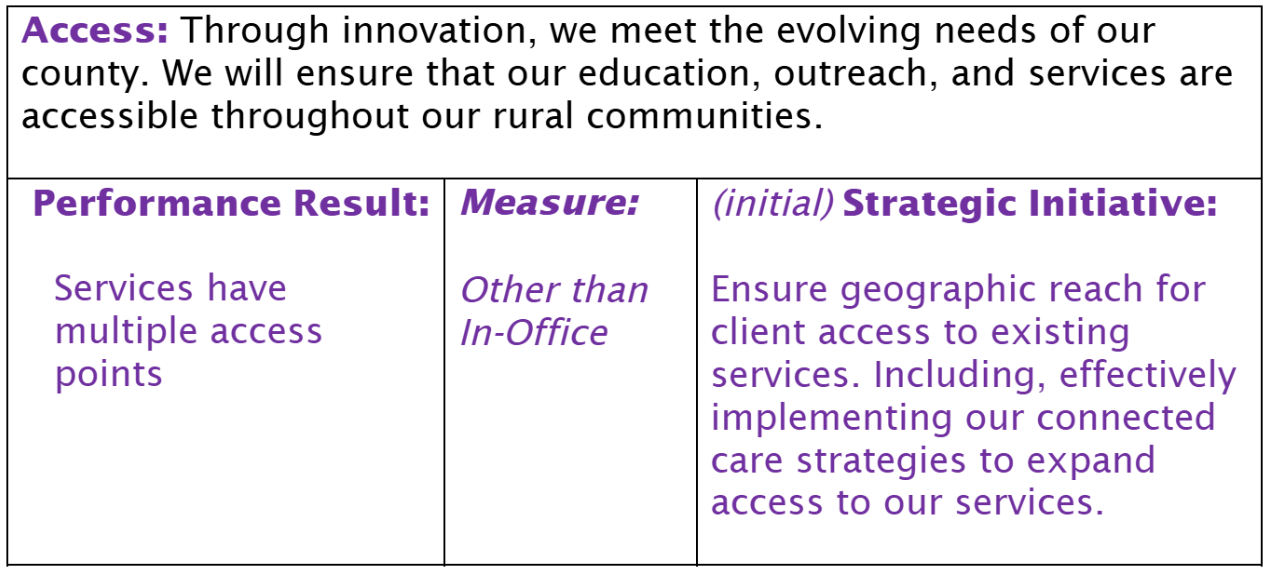
The layout of a strategic plan should make it clear which KPIs are aligned to which goals.
For example:
Quality #2 – Excellent organizational KPIs are direct evidence of the strategic goal.
It’s easy to list a bunch of KPIs that you already measure, that you already have data for, that other similar organizations are measuring in your sector. But none of these qualities is sufficient for ensuring your KPIs actually do give direct evidence of your organization’s specific strategic goals.
A school has a goal to “support the early development of children to provide them with the best possible start in life so they begin school ready to learn”. And the KPI for this goal is “Proportion of children enrolled in preschool the year before full time schooling”. How is enrollment in preschool direct evidence of how ready a child is to learn in school?
Consider the goal “Clients successfully reach their outcomes.” Which provides better evidence: “Successful Treatment Completion rate” or “Number of counseling sessions delivered”? The completion rate directly measures achievement; session counts only measure activity.
Quality #3 – Excellent organizational KPIs are quantitative.
Yeah, we hear you: “not everything is quantitative”. But actually, virtually all performance results that matter can be measured quantitatively. Paraphrasing Douglas Hubbard, author of “How to Measure Anything”, if you can observe or detect a difference, then you can measure it. If you can’t observe or detect a difference, why would you set a goal for it?
A national sporting association has a goal of “Corporate leadership and unity.” And they measure this with KPIs like “Leading by example as a National Organization” and “High level compliance to governance assessment completed”. These are not measures! KPIs measure results, and measuring means some degree of quantification. These KPIs read more like actions. Actions and measures are not the same thing.
To make their goal measurable, the sporting association would need to be more specific about the meaning of their goal. In particular, what difference is this goal about?
By way of another example: Instead of a vague KPI like “High level of community trust,” one could quantify this as: “Monthly referrals from community partners.”
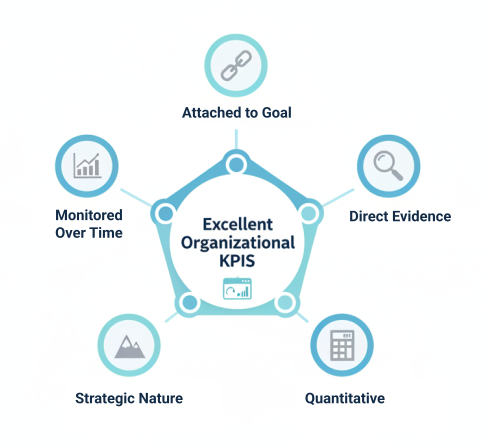
Quality #4 – Excellent organizational KPIs can be monitored over time.
A KPI is for steering, not judging. So, it’s of little use when it only tells you whether or not you achieved the goal…at the end. Excellent strategic KPIs can tell you to what degree you’re making a difference, as time goes by. Then you have the feedback to correct your course, if need be.
Measures that can’t be monitored over time are usually not real measures. A university has a strategic goal “Educational excellence”. And its KPI is “Full introduction of the Scientia Educational Experience with effective integration of online learning.” It’s not a real measure; it’s a milestone. How would they get feedback over time about how excellent their education is, so they could correct their course if this initiative doesn’t work?
In mental health care, tracking “percentage of current clients with a mental health visit to the ER” monthly allows understanding of organizational impact over time. Whereas a milestone like “Create new mobile crisis program” only tells you if you finished—not whether it’s improving outcomes.
Quality #5 – Excellent organizational KPIs are strategic in nature, not operational.
A KPI is strategic when it measures a change the organization is trying to make that is proactive, future-oriented, and about improving how it fulfills its mission and reaches for its vision. It’s a KPI that measures a change that the senior leadership team can be responsible for.
A KPI is operational when it measures a result produced by a part of the organization, like a business process or function. It still is about improving performance. But it’s a KPI that measures a change that a team within the organization can be responsible for.
The idea is that operational KPIs are the drivers (causes) of the strategic or organizational KPIs. But they are not evidence of the strategic or corporate goals.
The KPI from the energy and water authority mentioned above was “Stakeholder regulatory compliance.” We’d suggest that compliance is never a strategic result! It’s a hygiene factor; particularly for an industry that has been regulated as long as this one.
“Number of unique clients served” might be strategic if your mission focuses on expanding reach in your region. But “Staff Training Hours” is operational—a driver that influences strategic results, not a direct evidence of strategic goals.
This is a flaw that a lot of corporate KPIs have: they measure operational results that might have a causal effect on the strategic goal, but still are not evidence of whether the goal is being achieved.
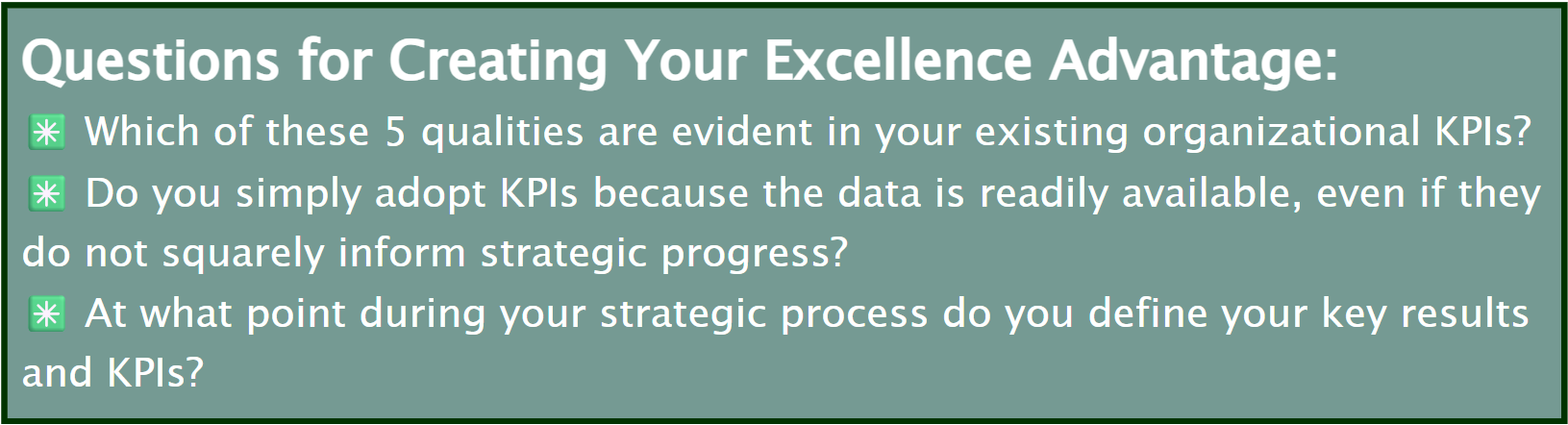
How excellent are your organization’s strategic KPIs?
We encourage you to Download this template, and do a quick assessment.
When your KPIs exhibit these five qualities, they transform from numbers on a dashboard report into powerful tools for organizational improvement—guiding your team toward the meaningful impact your strategies describe and your communities and stakeholders deserve.
If you’d like to receive these Inspirations in your inbox every other week, you can subscribe to Kathy’s Excellence Advantage Inspirations Newsletter.
Kathy Letendre, President and Founder of Letendre & Associates, advises organizations and leaders to create their excellence advantage.
Contact Kathy by phone or text at 802-779-4315 or via email.