Certain Uncertainty
Setting a strategic course is crucial for long-term success. This becomes trickier in a period of significant flux in your region or sector.
Further, there are points of inflection in an organization’s chosen trajectory. Points where major changes are certain, but the form is unclear.
In both of these circumstances, preparation is still useful; otherwise, we risk limiting our future alternatives.
This uncertainty requires strategic thinking and planning that explicitly considers the ambiguous future.
Let me illustrate with two examples:
Organization #1 is a mid-size organization with a solid reputation, good quality, and decent financial health. They operate in a competitive area where their customers have choices.
Organization #2 is medium-sized in their sector, with a strong reputation, very good quality, and a solid financial health. They are in a highly regulated industry where competition is minimal due to the regulatory structures in place.
For each organization, it is predicted that there will be major shifts in the regulatory and/or competitive environments over the next 2-5 years. However, the nature of these changes, as well as the timing of such are unclear.
Through strategic planning, we have identified that smart preparation steps now may create more options in the future. Whereas, waiting for greater clarity would conserve resources but may limit future choices.
What to do?
Organization # 1 has identified, through scenario-based planning, vital elements needing attention. By shoring up some internal operational and financial aspects in the coming year, they will be better positioned for a wide range of scenarios.
Organization #2 has undertaken a similar approach to inform its near-term preparations.
Each has chosen an active rather than wait and see approach. While they face uncertainty, they are taking steps to prepare for a number of possible paths.
Scenario-based planning can be particularly useful when there are a range of future scenarios but their likelihoods are unknown.
Each organization has:
- Contemplated a number of future scenarios.
- Gathered a range of perspectives.
- Examined each scenario from different angles.
- And determined next steps to prepare for each scenario.
A number of common elements became evident and from this they have assembled a plan of action.
Through scenario-based planning processes, each organization has proactively identified steps they can initiate with confidence. Recognizing that while others in their area may wait for things to be clearer, they are investing time and resources into strategic activities that will yield benefits over a range of possible scenarios.
This is at the core of scenario-based planning. To examine enough varied scenarios to develop confidence in prudent action steps.
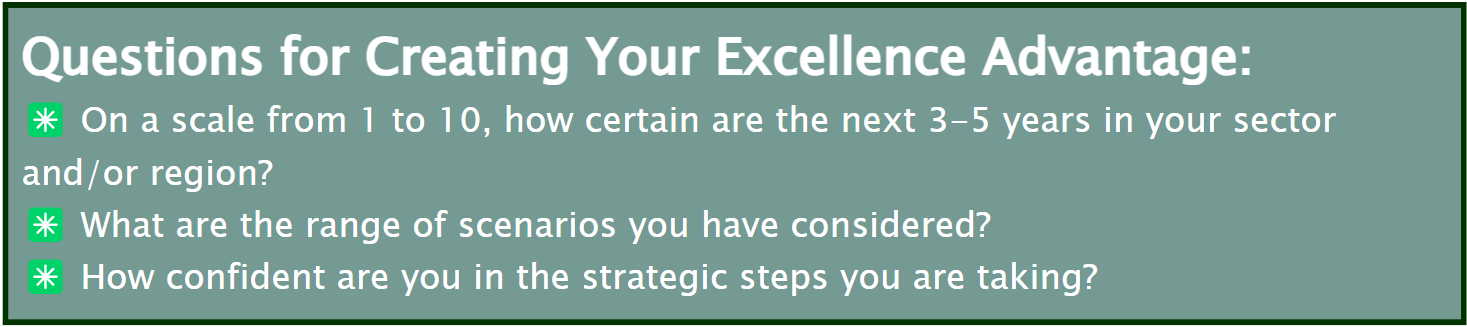
If you’d like to receive these Inspirations in your inbox every other week, you can subscribe to Kathy’s Excellence Advantage Inspirations Newsletter.
Kathy Letendre, President and Founder of Letendre & Associates, advises organizations and leaders to create their excellence advantage.
Contact Kathy by phone or text at 802-779-4315 or via email.