
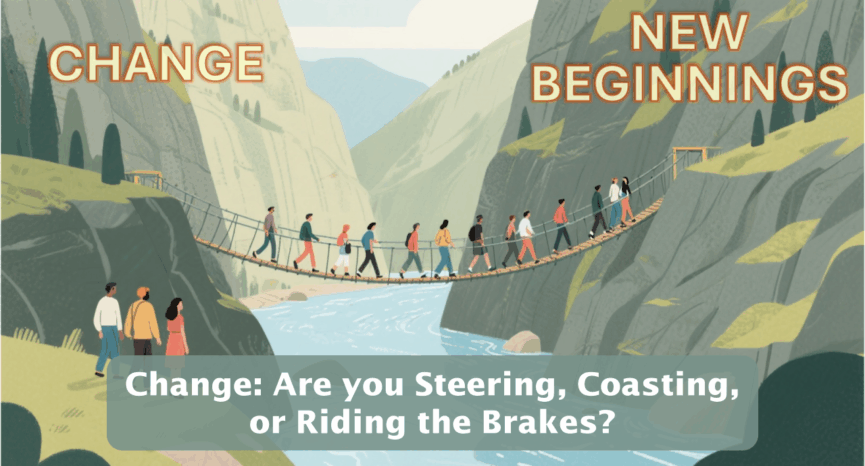
Every organization goes through change. Some years bring one or two big shifts. Others—well, a tidal wave.
Take, for example, a healthcare organization I have begun working with recently. They have navigated multiple significant changes in a single year. And now are preparing to move from an electronic medical record (EMR) system they have relied on for 20 years to a completely new platform.
It’s hard to overstate the scale of this change. For clinicians and staff, the old EMR isn’t just a tool—it is muscle memory. Clunky yes, but staff know all the clicks and clunks of it. Changing it means rethinking everyday workflows, learning new technology, and letting go of habits that have been built over decades.
And while technology changes like this can be exciting for many, they can also be overwhelming for some. That’s why managers and leaders play such a critical role—not just in managing the change, but in guiding people through the transition.
Change vs. Transition: A Crucial Distinction
William Bridges, a pioneer on transitions, makes the point that:
- Change is the external event—like launching a new EMR.
- Transition is the internal process people go through to adapt to the change.
In his book, Managing Transitions, he describes three phases:
- Ending, Losing, Letting Go – Acknowledging what’s going away and helping people process the loss.
- The Neutral Zone – The middle period where the old way is gone but the new way hasn’t yet become comfortable.
- The New Beginning – When people embrace the change and feel confident in the new environment.
Source: Managing Transitions, William Bridges, PhD with Susan Bridges, 2016
My client’s EMR project is a perfect example: no one could just “flip a switch” from the old to the new. Managers have to be a steady presence to help people work through each stage of their individual transition… recognizing that people move at different paces.
Going from being an expert in the old, to a novice in the new. Unlearning, while learning. Building new routines.
The ADKAR Model: A Leader’s Checklist for Change
As Bridges gives us the human, psychological journey, Prosci’s ADKAR model gives us a practical roadmap for helping individuals move through the transition.
Successful, lasting change requires:
- Awareness – Do people understand what is changing and why
- Desire – Do they see the benefits and want to make the change
- Knowledge – Do they know how to operate in the new way
- Ability – Can they actually perform in the new environment
- Reinforcement – Are we making sure the change sticks over time?
Source: Adapted from Prosci’s ADKAR Model. The ADKAR Advantage, Karen Ball, 2024

In the EMR example, managers play a vital role at each step. They work to create awareness by painting a picture of the future—better care coordination, fewer steps to document the care plan, enhanced ways to connect with providers outside the system, perhaps even a selling point when recruiting new staff who want the latest tools.
As we explored change and transition, managers began to see how they personally can help build desire for change by connecting to the benefits that matter most to each person on their team. They provide knowledge and foster ability through well-designed training, job aids, reference materials, and space for practice (a safe place where learning is welcomed!). Finally they can reinforce the change, once underway, with ongoing 1-on-1 coaching and recognition of successes.
People don’t commit to change from a memo. They commit because they’ve had repeated, personal conversations with a manager or peer they trust.
As a leader, your job is to be the bridge between “what’s changing” and “how we make it work well.” That means:
- Talking about the why behind the change.
- Listening for concerns and addressing them with empathy.
- Valuing the different learning styles of people.
- Reinforcing benefits and celebrating wins along the way.
Tips for Any Change
- Model the mindset you want to see. Your tone and attitude toward the change will influence your team.
- Use ADKAR as a guide. Ask yourself where each person is in the process and what they need next.
- Acknowledge the emotional side. People may feel loss, uncertainty, or frustration. Name it, normalize it, and work through it.
- Communicate in layers and listen. Share key messages often and through multiple channels. Remember: people need to hear important messages several times before they stick. And two-way communication is vital.
Organizational change succeeds when individuals make successful transitions.
Whether you’re implementing a new system, restructuring a department, or rolling out a new strategic initiative, the combination of Bridges’ Transition Model and ADKAR provides a powerful framework.
Your role isn’t just to oversee the technical side of change—it’s to lead people through the human side, step by step, side by side. Do that well, and you help your team not just survive change, but thrive because of it.
If you’d like to receive these Inspirations in your inbox every other week, you can subscribe to Kathy’s Excellence Advantage Inspirations Newsletter.
Kathy Letendre, President and Founder of Letendre & Associates, advises organizations and leaders to create their excellence advantage.
Contact Kathy by phone or text at 802-779-4315 or via email.